

Yes, Afro streetwear belongs in your everyday office wardrobe. A heavyweight tee, a well-cut hoodie, or a graphic piece with African motifs reads as professional the moment you choose quality construction and style it with restraint. Afro Urban Apparel builds pieces around that exact principle: fabric weight and clean design that let heritage speak without shouting.
TL;DR:
- Most office dress codes allow heavyweight Afro streetwear pieces layered under blazers or coats, especially in business casual or creative environments.
- Look for T-shirts with a GSM around 220, made of combed ring-spun cotton, and ensure hoodies use heavy fleece or double-layer knit to maintain structure over time.
- Styling should focus on one statement piece with support from neutral layers and footwear, avoiding stacked loud prints or oversized silhouettes.
- Heavyweight fabrics require careful maintenance, including cold washing inside out, low-heat drying, and garment rotation to preserve shape and graphics.
- Cultural heritage shows best when carried subtly through small motifs, muted colors, or accessories, rather than loud or all-over prints, especially in conservative workplaces.
Table of Contents
- What Counts as Ropa Afro en Oficina, Exactly?
- How Do You Style Afro Streetwear for Work?
- What Fabric Specs Should You Actually Check Before Buying?
- How Do You Keep Heavyweight Pieces Office-Ready?
- Do Most Office Dress Codes Actually Allow This?
- What Do Acceptable Outfits Look Like by Workplace Type?
- How Do You Advocate for Wearing Afro Streetwear at Work?
- Why Heritage Carried Lightly Beats Heritage Worn Loudly
- Afro Urban Apparel: Built for the Version of Heritage You Wear Every Day
- Sources
- FAQ
What Counts as Ropa Afro en Oficina, Exactly?
When people search “ropa afro en oficina,” most are not asking about formal African workwear like tailored dashikis, peplum skirts, or ceremonial wraps for business settings. That’s a real category, but a different one, with different fabrics and different occasions. This guide is about something else: everyday Afro streetwear.
Think heavyweight t-shirts, structured hoodies, and accessories that pull African cultural elements, Adinkra symbols, indigenous textile patterns, bold graphic prints, into modern street silhouettes. Designers building in this space describe it as intentional and understated, not costume, not spectacle. That distinction matters for how you shop and how you wear it.
A dashiki suit and a heavyweight graphic hoodie both carry African identity, but they serve different rooms. One is for a wedding or a ceremony. The other is for a Tuesday at your desk, a client call, a coffee run before a meeting. Afro Urban Apparel’s collection sits squarely in the second category: streetwear built heavy enough to hold its shape through a workday and designed with enough restraint to read as considered rather than loud.
How Do You Style Afro Streetwear for Work?
The formula is simpler than most people think: one statement piece, one neutral anchor, clean footwear. Never stack two loud prints or two oversized silhouettes in the same outfit. Pick a single focal point and let everything else support it.
Here are five outfit combinations that hold up in most office environments:
- Graphic tee under a blazer. A heavyweight tee with a chest-level African motif, tucked or half-tucked, under a solid-color blazer. The blazer does the formal work; the tee carries the identity.
- Hoodie layered under a wool coat. A structured hoodie in a muted colorway, zipped or half-zipped, under outerwear. Only the collar and hem show, which keeps it subtle for conservative offices.
- Tee with tailored trousers, not jeans. Swapping denim for a tapered trouser instantly shifts a graphic tee from weekend to weekday.
- Small-motif tee with sneakers, clean not chunky. A low-profile leather sneaker in white or black reads more office-ready than a bulky trainer.
- Accessory-led minimalism. Skip the graphic entirely and carry heritage through a woven belt, a small enamel pin, or a patterned pocket square, paired with an otherwise plain outfit.
Print scale matters more than people realize. A large, busy motif covering the whole chest works for casual settings. In a conservative office, choose a smaller placement print, a sleeve detail, a breast-pocket graphic, or a monochrome version of a bolder design. Save the largest, most vivid graphics for Fridays or creative-industry offices where visual expression is already part of the culture.
Balance proportions deliberately. If your top is oversized, tighten the bottom half with tapered trousers or a fitted skirt. If your hoodie is boxy, choose slim denim or trousers underneath so the whole silhouette doesn’t read as loungewear.
Pro Tip: Keep one “quiet” Afro streetwear piece in rotation, a tee with a small embroidered symbol instead of a full-front print, for days when you need heritage on your body but nothing louder than a whisper.
What Fabric Specs Should You Actually Check Before Buying?
GSM, grams per square meter, is the single number that tells you the most about how a piece will hold up. Heavyweight cotton has a GSM range considered to create structure and durability that define premium streetwear silhouettes, and it ages into a texture and drape that light cotton never develops.
For t-shirts specifically, the practical target sits in the a respectable GSM range for t-shirts range, using combed ring-spun cotton. That fiber process removes short, weak fibers and aligns the rest, which is why combed ring-spun cotton feels smoother and resists pilling better than standard carded cotton. Hoodies need more weight to hold an architectural shape: a heavier GSM range for hoodies with fleece or double-layer construction keeps a hood and body from collapsing after a few washes.
| Garment type | Target GSM | Fabric detail | What to check |
|---|---|---|---|
| Everyday tee | 220 GSM | Combed ring-spun cotton | Rib collar with a small percentage of elastane |
| Structured hoodie | Higher GSM range for structured hoodies | Heavy fleece or double-layer knit | Taped neckline, reinforced cuffs |
| Graphic tee (printed) | 220 GSM | Combed ring-spun cotton | Double-needle stitching on seams |
Construction details separate a piece that lasts a year from one that lasts a week. A 2x2 rib collar with elastane keeps its shape after repeated wear instead of stretching into a loose ring. Double-needle stitching on seams and taped necklines prevent the early puckering and stretching that plague cheaper streetwear. Expect to pay more for these specs. A $25 tee rarely hits 220 GSM with combed cotton; the price difference is the fabric, not the branding.
How Do You Keep Heavyweight Pieces Office-Ready?
Heavyweight fabric holds up longer than lightweight cotton, but only if you treat it right. Follow these steps to protect fabric weight, shape, and graphics over years of wear, not months:
- Wash cold and inside out. Cold water and an inside-out wash protect both the fabric surface and any printed graphic from friction and fading.
- Skip the dryer’s high heat. Line dry or use a low-heat, tumble-dry-low setting; high heat breaks down elastane in ribbed collars and cuffs faster than anything else.
- Fix small seam issues immediately. A loose thread at a cuff or collar left alone becomes a full unraveled seam within weeks.
- Rotate your pieces. Wearing the same hoodie twice a week doubles its wear rate; a rotation of four or five pieces cuts stress on any single garment in half.
- Store folded, not on a thin hanger. Heavyweight cotton stretches at the shoulders on flimsy hangers over time; folding on a shelf holds shape better.
- Treat pilling with a fabric shaver, not scissors. A quick pass with a fabric shaver on any pilled area restores a clean surface without damaging the weave.
Do Most Office Dress Codes Actually Allow This?
Office dress codes fall into three rough categories, and Afro streetwear fits two of them cleanly. Business casual, the most common code in modern offices, allows collared shirts, clean sneakers, and structured knitwear, which is exactly the territory a well-made graphic tee or hoodie occupies when layered correctly. Casual and creative offices go further, often welcoming bold prints and full-front graphics without any styling gymnastics required.
Strict corporate dress codes, think law firms, banks, and traditional finance, are the one category where full-graphic streetwear conflicts outright. But that conflict is about visual boldness and formality level, not about African cultural content specifically. A loud band tee would face the same pushback in that environment. The workaround isn’t avoiding Afro streetwear; it’s choosing the quieter version, small motifs, muted colorways, layered under blazers, described in the styling section above.
Most written dress code policies say nothing about cultural prints one way or the other. They restrict logos, graphics, or “casual attire” in general terms, which leaves room for interpretation. That ambiguity cuts both ways: it means a manager could object on a technicality, but it also means there’s rarely an explicit rule you’re breaking. Knowing your specific workplace’s actual policy, not the unwritten assumptions people carry about it, is the first real move.
What Do Acceptable Outfits Look Like by Workplace Type?
The right outfit depends entirely on which of three rough environments you work in.
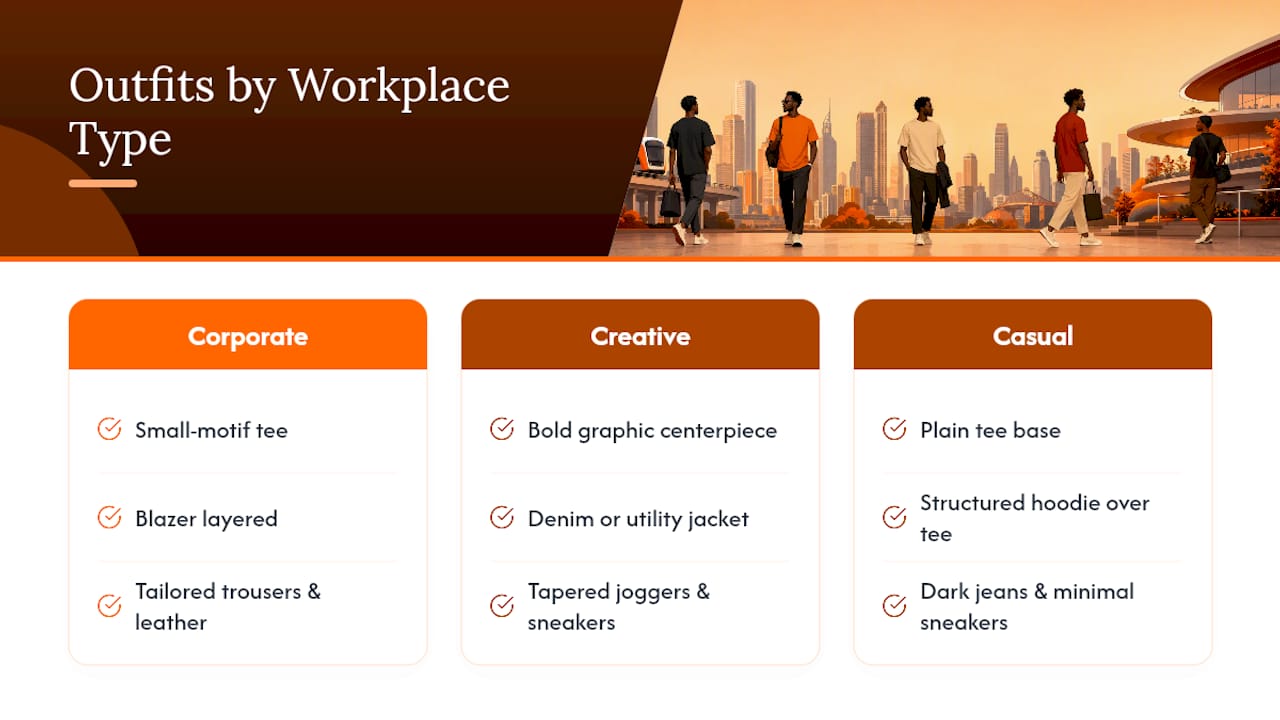
In a strict corporate office, layer a small-motif heavyweight tee under a solid blazer, paired with tailored trousers and leather shoes. The graphic becomes a private detail rather than a public statement, visible at the collar or cuff but not dominating the outfit. This is where the “quiet” piece from your rotation earns its place.
In a creative or design-forward office, wear the graphic tee as the outfit’s centerpiece. A bold African Mask Graphic Tee with tapered joggers or straight-leg trousers and clean sneakers reads as intentional style in an environment that already values visual expression. Layer a denim or utility jacket over it if the office skews toward outdoor-adjacent creative work.
In a casual startup or hybrid office, a structured hoodie over a plain tee, paired with dark jeans and minimal sneakers, works without any adjustment. This is the environment with the fewest restrictions, and it’s also where accessories, a woven bracelet, a pin, a patterned cap, do the most work at low volume.
Across all three, the constant is proportion and print scale. Adjust those two variables and the same core wardrobe moves between environments without needing three separate closets.
How Do You Advocate for Wearing Afro Streetwear at Work?
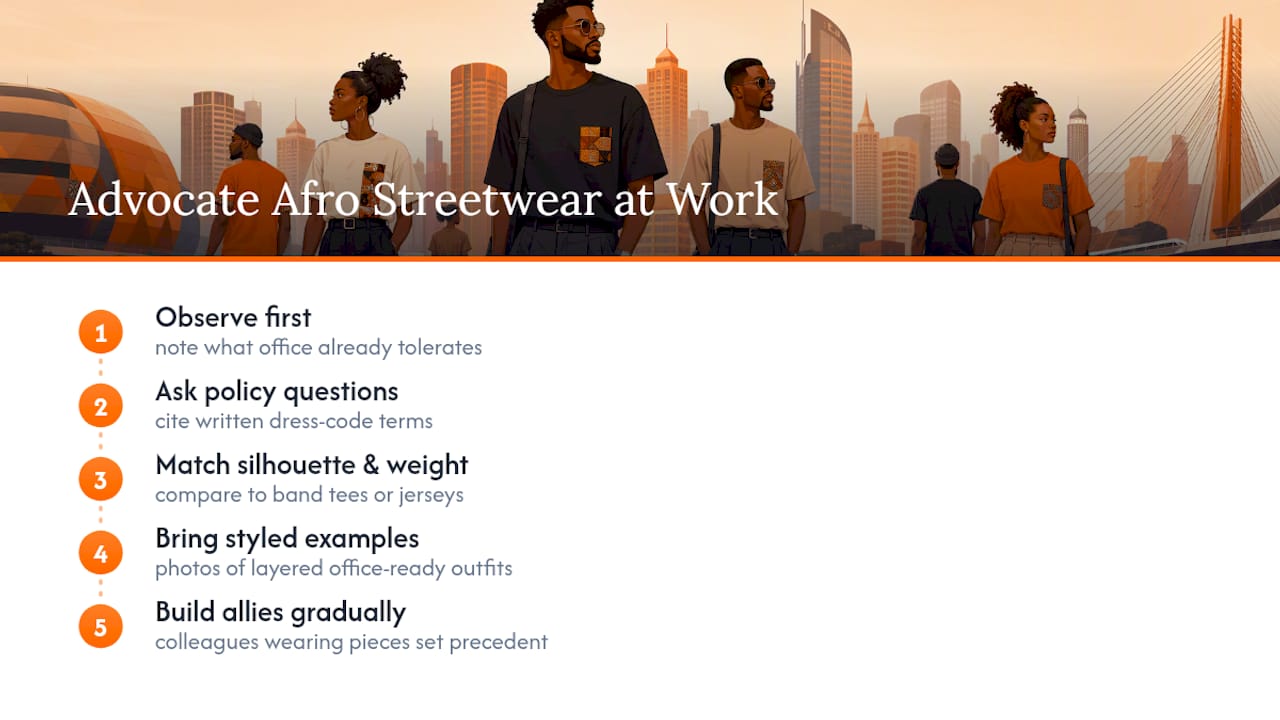
Start with observation before conversation. Notice what your specific office already tolerates in terms of graphic tees, hoodies, and casual layering, regardless of the print, before assuming a cultural print faces a different standard.
If a manager or HR raises a question, frame the conversation around the actual policy language, not personal taste. Ask directly what the written dress code restricts: logos, graphic size, casualness level. If a band tee or a sports jersey would pass, a well-constructed Afro streetwear piece in the same silhouette and weight category should pass under the same logic. Cultural content isn’t a formality violation; visual boldness sometimes is, and that’s a separate, negotiable variable you can adjust through styling.
Bring examples when useful. A photo of a layered outfit, hoodie under a blazer, graphic tee under a cardigan, does more to shift a manager’s assumption than an argument about representation alone. Most pushback on cultural attire comes from unfamiliarity with how the piece can be styled, not outright rejection of the content.
Build allies gradually. Once one or two colleagues wear similar pieces without incident, informal precedent does more to normalize the wardrobe than any single conversation. Designers in this space talk about creating pieces that carry authorship and truth across different rooms and cities; the same principle applies to advocating for them at your desk. Confidence in the clothing, backed by genuine quality, tends to do more persuading than any policy debate.
Why Heritage Carried Lightly Beats Heritage Worn Loudly
Cultural reclamation doesn’t require volume. Wearing a heavyweight tee with a small Adinkra symbol to a Tuesday meeting is still an act of authorship, arguably a more sustainable one than reserving identity for special occasions. Design commentators frame daily wear of heritage pieces as active authorship for diaspora communities, and that framing changes how you should shop.
Designers who build for longevity, for pieces that still feel right in five years, prioritize fabric truth over trend chasing. That means heavier cotton, better stitching, and restraint in graphic placement over flashy but flimsy production. A piece that ages into a patina rather than falling apart after ten washes carries more meaning with every wear, not less.
Buy fewer pieces, built better. That’s the whole argument.
— Kebz
Afro Urban Apparel: Built for the Version of Heritage You Wear Every Day
This brand offers streetwear designed for daily wear that balances cultural design elements with practicality. Their pieces emphasize durable fabric weight, reinforced construction, and meaningful prints without loudness.
The Renaissance Tee sits in the heavyweight range this guide recommends, combed cotton with a rib collar built to hold its shape through repeated office wear. Layer it under a blazer for corporate settings or wear it solo on casual days. The Afro Butterfly Hoodie delivers the structured, boxy silhouette that only comes from proper fleece weight, ideal as a mid-layer under a coat for cooler office mornings. For readers who want a bolder statement in creative or casual workplaces, the African Mask Graphic Tee brings a larger motif built on the same heavyweight base.
Sizing runs true to standard streetwear fit; if you plan to layer pieces under blazers or coats, most customers size true rather than up. Expect garment-washed pieces to soften slightly after the first wash while holding their weight and shape. Browse the full Afro Urban Apparel collection to find the pieces that fit your specific office and start building a wardrobe that carries heritage every single day, not just on occasions.
Sources
- What Makes Heavyweight Cotton the Absolute Preferred Fabric for Premium Streetwear Brands?
- The surge of streetwear in Latin America: Mexico, Brazil and Colombia redefine urban fashion
- Tobi Osinowo on otỌto and the future of African streetwear
FAQ
Is It Appropriate to Wear African Print Streetwear at Work?
Yes, when the piece is heavyweight, well-constructed, and styled with restraint, small-motif graphics, layered under blazers or cardigans, it fits most business casual and creative office dress codes without conflict.
What GSM Should I Look for in an Office-Ready Tee?
Look for a respectable GSM range for t-shirts in combed ring-spun cotton; that range holds shape through a workday and resists the thinning that lightweight tees show within months.
Can a Hoodie Ever Work in a Corporate Office?
Yes, if it’s layered under a coat or blazer with only the collar visible, and if the fabric is heavy enough, 350 GSM or above, to hold a structured shape rather than sag.
How Is Afro Streetwear Different From Traditional African Workwear?
Afro streetwear means heavyweight tees, hoodies, and accessories with African motifs in modern silhouettes, while traditional African workwear refers to tailored formal pieces like dashikis or peplum skirts meant for ceremonial or explicitly formal settings.
Where Can I Buy Durable Afro Streetwear for Everyday Office Wear?
Afro Urban Apparel builds its collection specifically around heavyweight fabric and restrained cultural design, including the Renaissance Tee and the Afro Butterfly Hoodie, both suited to daily office rotation.