

Afrofuturism moda fuses ancestral African craft with speculative, future-facing design, using textiles, sculptural silhouettes, and performance to reimagine Black identity outside colonial narratives. You see it in kente-inspired tailoring, in Wakandan armor from Black Panther, and in the geometric prints Howard Magazine traces back to diasporic speculative thought. It matters because it treats heritage as forward motion, not nostalgia.
TL;DR:
- Authentic Afrofuturist fashion emphasizes traditional textiles like kente and adire combined with futuristic shapes, fabrics, and technological details.
- Designers such as Mdingi, and film productions like Black Panther, showcase the movement’s focus on craft, cultural continuity, and storytelling through apparel.
- The aesthetic promotes identity reclamation and cultural healing by centering African techniques and resisting colonial narratives.
- To wear Afrofuturist style authentically, focus on one statement piece, prioritize craft provenance, and choose durable, handmade textiles over superficial patterns.
- The movement values technique and construction more than print scale or visual spectacle, emphasizing heritage as part of everyday fashion rather than costume.
Table of Contents
- Origins: How Music, Literature, and Film Built Afrofuturist Fashion
- The Visual Vocabulary: Textiles, Silhouettes, and Techniques That Define the Look
- Designers and Cultural Moments That Put the Aesthetic Into Practice
- Fashion as Protest: Identity, Healing, and Cultural Reclamation
- How to Wear Afrofuturist Elements Without Turning Them Into Costume
- Where the Expertise Behind This Guide Comes From
- Where to Read More on Afrofuturism and Fashion
- Why Afrofuturism Deserves More Than a Trend Cycle
- Wear the Philosophy, Not Just the Print
- Sources
Origins: How Music, Literature, and Film Built Afrofuturist Fashion
The aesthetic didn’t start on a runway. It started with Afrodiasporic writers and musicians in the mid-20th century who imagined Black futures where colonization never dictated the terms. Sun Ra’s cosmic performance costumes in the 1950s and 1960s planted a visual language, mixing ancient Egyptian references with space-age materials, that fashion designers would return to decades later.
By the 2010s, that undercurrent surfaced in mainstream culture through a handful of pivotal moments:
- Janelle Monáe’s android-inspired stage wardrobes translated Afrofuturist theory into wearable performance art.
- Black Panther (2018) visualized Wakanda’s textiles and armor at a budget and scale no prior Black-led production had reached.
- Beyoncé’s Black Is King staged Afrotopian aesthetics as a visual album, pairing traditional beadwork with futurist styling.
- Museum programming, especially the Africa Fashion exhibition, gave curators a public platform to frame these garments as historical continuity rather than costume, a shift Art Africa’s coverage of the Brooklyn Museum exhibition documents in detail.
Those four moments moved Afrofuturism from a niche literary and musical subculture into something stylists, retailers, and museum curators now treat as an established design vocabulary.
The Visual Vocabulary: Textiles, Silhouettes, and Techniques That Define the Look
You can spot afrofuturistic clothing by its materials before you spot it by its shape. Kente cloth, adire indigo-resist dyeing, and raffia weaving anchor the aesthetic in specific West African traditions rather than a generic “tribal” gesture. Howard Magazine’s overview of the movement notes that Afrofuturism in fashion consistently pairs these traditional textiles with technological or avant-garde forms, geometric prints, metallic finishes, sculptural volume, rather than treating heritage and innovation as opposites.
A few recurring signatures show up across collections and costume design:
- Fabric: hand-woven kente, adire indigo dye work, raffia fiber, and heavyweight cotton that holds structured shapes.
- Silhouette: sculptural tailoring that exaggerates shoulder or hip lines, hybridized with traditional wrap and drape cuts.
- Adornment: beadwork, metallic embroidery, and cowrie shell detailing used as narrative markers, not just decoration.
- Color and pattern: high-contrast geometric prints and saturated color blocking that reads as bold from a distance.
- Material innovation: experiments with recycled fiber and low-impact dyeing, since sustainable production increasingly sits inside the movement’s own values rather than outside them.
Wearable tech shows up too, though more often in runway and costume work than in ready-to-wear: LED trim, reflective fiber, and 3D-printed accessories that echo the “future” half of the term. In everyday apparel, that translates more modestly into structured silhouettes and heavyweight fabric built to hold its shape and its color.
Pro Tip: Look at the seams and the dye before the print. A garment that pairs a traditional technique (hand-weaving, resist-dyeing) with a modern cut is usually closer to the real aesthetic than one that just prints an “African-looking” pattern on a plain T-shirt.

Designers and Cultural Moments That Put the Aesthetic Into Practice
Afrofuturist fashion is easiest to understand through specific work rather than abstract description. A few reference points show how the theory becomes cloth.
- Lukhanyo Mdingi and the craft-first approach. Academic coverage of fashion activism singles out designers like Mdingi for grounding collections in specific ethnic references and local craftsmanship rather than generic “African print” shorthand, treating textile technique as the message.
- Wakandan costume design in Black Panther. The film’s armor and ceremonial wear pulled directly from real textile traditions, Basotho blankets, Maasai beadwork, Tuareg silver, and rendered them at blockbuster scale, which is largely why the film became a fashion reference point rather than just a cinematic one.
- Beyoncé’s Black Is King styling. The visual album staged beadwork, body paint, and sculptural headpieces as a continuous costume narrative, reinforcing the idea that garments can carry a story arc the way a film does.
- Domestika’s designer profiles. Editorial coverage from Domestika documents how emerging designers combine storytelling, craft, and live performance, showing that Afrofuturist design often lives as much in the presentation as in the garment itself.
- Diaspora remix pieces documented by cultural journalism. Coverage from outlets like Refinery29 shows everyday designers remixing ancestral dress with sci-fi styling cues, proving the aesthetic isn’t confined to museums or film budgets.
Fashion as Protest: Identity, Healing, and Cultural Reclamation
Afrofuturist fashion carries a political charge that a lot of casual coverage skips past. Designers use clothing to resist colonial narratives that framed African dress as static or primitive, replacing that framing with garments that claim a self-determined future. Academic work on fashion activism describes this directly: designers who reference specific ethnic craft traditions are making a deliberate choice to assert identity and recover craft rather than produce decoration.
Brooklyn Museum curators frame this even more specifically as restorative practice.
Afrofuturism in fashion re-centers African histories and traditions, using circular rather than linear conceptions of time as a design resource, imagining futures rooted in cultural continuity instead of a Western techno-utopian break from the past.
That framing, drawn from the museum’s Afrotopia commentary, reframes hand-weaving and dyeing as intergenerational transmission, skills passed down as a form of healing, not just aesthetic choice. Fashion Revolution’s writing on communication and Afrofuturism makes a parallel point: garments function as a channel for political messaging and community narrative, which is part of why social media and museum programming have amplified these designers so quickly. A single well-photographed collection can travel from a local studio to a global feed in days.
How to Wear Afrofuturist Elements Without Turning Them Into Costume
You don’t need a runway budget to wear this aesthetic honestly. You need intention.
- Start with one signature piece, not five. A structured kente-print jacket or an indigo-dyed piece paired with plain denim reads as confident; five loud pieces at once reads as costume.
- Mix Afro-minimal with Afro-maximal deliberately. A quieter palette with one bold accessory, cowrie jewelry, a beaded cuff, carries the same cultural weight as a full-print outfit and suits more everyday settings.
- Ask who made it and how. Provenance matters. A maker who can name the dye technique or weaving region is a good sign; a brand that can’t is a red flag.
- Care for hand-made textiles properly. Hand-dye and hand-weave pieces usually need cold water and air drying, not a machine cycle that will bleed indigo or fray raffia trim.
Pro Tip: If a retailer can’t tell you where a print or weaving technique originated, treat that as a sourcing question worth asking twice before you buy.
Where the Expertise Behind This Guide Comes From
This guide draws on museum scholarship, cultural journalism, and design practice rather than trend forecasting alone. A few notes on how that expertise shapes the coverage:
- Editorial contributor Kebz researches African diaspora fashion history and cultural commentary, connecting museum framing to everyday wardrobe practice; related coverage of modern African fashion expands on the craft context referenced above.
- Afrourbanapparel builds its own streetwear around the same principles curators describe: heavyweight fabric construction and heritage motifs applied to daily wear rather than occasion wear, a philosophy explored further in why heritage-inspired streetwear matters.
- Design choices referenced here, weaving, resist-dyeing, embroidery, are treated as living technique, not archived history.
Where to Read More on Afrofuturism and Fashion
- Afrotopia — Brooklyn Museum: the strongest curatorial source for how Afrofuturism functions as restorative design practice.
- Afrofuturismo — Wikipedia (Spanish): a broad, referenced primer if you want scope across literature, music, and film.
- Comunicação, Moda e Afrofuturismo — Fashion Revolution: connects fashion communication theory to activist practice, with further bibliography.
Why Afrofuturism Deserves More Than a Trend Cycle
The conventional coverage of this movement tends to flatten it into a seasonal aesthetic, bold prints, sci-fi references, done. That reading misses the actual argument designers and curators are making: that African futures are legitimate design territory, not a genre borrowed from Western science fiction and decorated with African patterns.
What gets underestimated is how much of the meaning lives in technique rather than image. A printed kente pattern on fast fashion and a hand-woven kente panel carry the same visual signal in a photo and almost nothing in common as objects. One took a weaver days; the other took a printer minutes. If you’re evaluating a garment, that’s the distinction worth prioritizing over color or silhouette.
The Afro-minimalism versus Afro-maximalism debate is a useful lens here too. Both are legitimate expressions of the same underlying idea, that African aesthetics don’t need to shout to carry weight, and treating minimalism as a lesser or diluted version misreads the movement entirely. What matters most is whether a garment’s construction honors the craft it references. Everything else, print scale, color saturation, styling drama, is preference, not principle.
— Kebz
Wear the Philosophy, Not Just the Print
Some brands build heavyweight streetwear, T-shirts, hoodies, and accessories around the principle this guide has walked through: heritage as daily wear, not a costume reserved for special occasions.
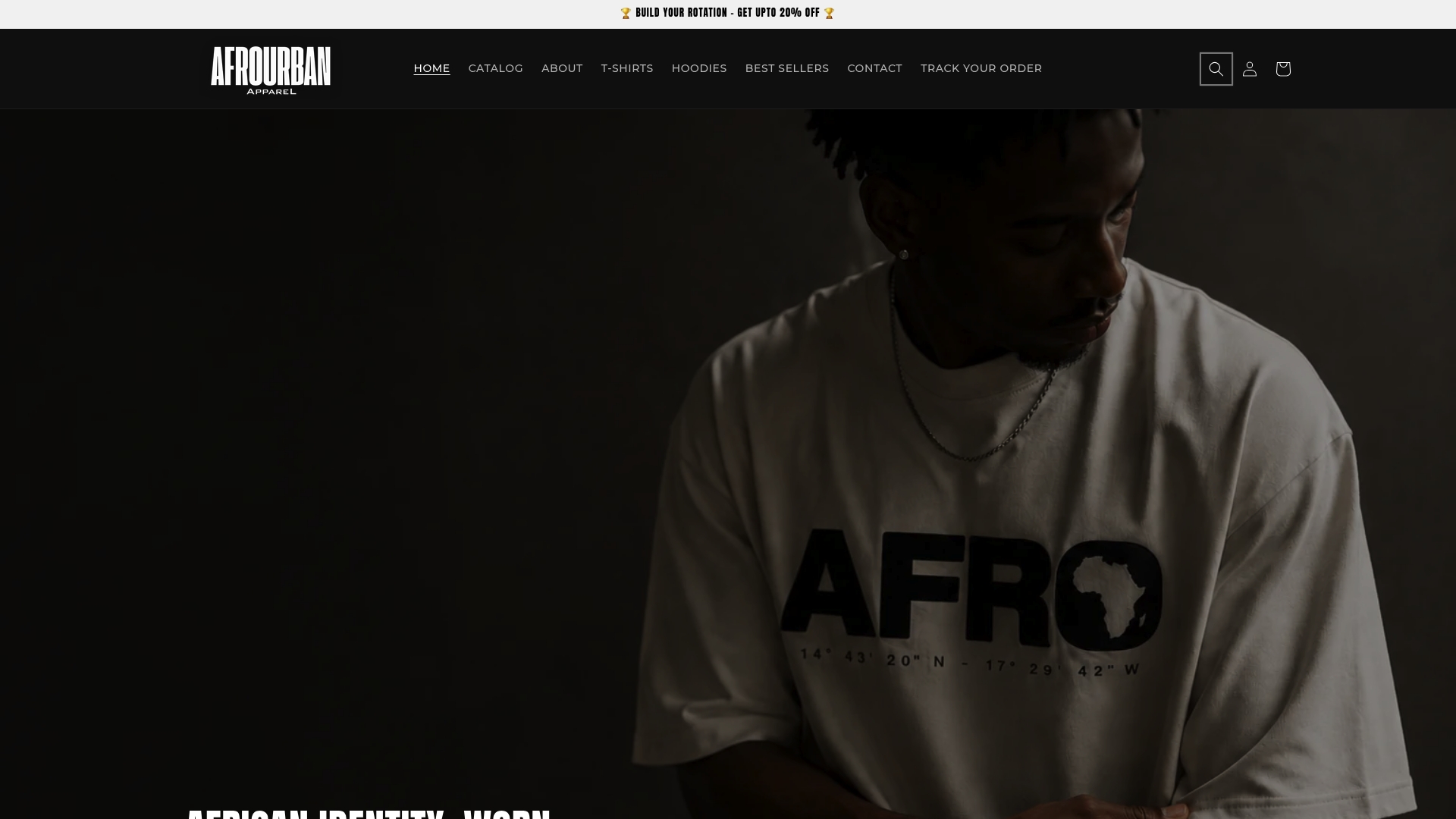
Where a lot of Afrofuturist-adjacent fashion stops at surface-level print work, some approaches lean on durable, heavyweight fabric and embroidered detail meant to hold up to actual daily use, not a single photo. That’s the gap this guide has pointed to all along: technique and construction matter more than a pattern printed onto a thin T-shirt. If the ideas in this guide resonated with you, browsing the current Afro Urban Apparel collection is the direct next step toward wearing them rather than just reading about them.
Sources
- Afrofuturism and the future — Howard Magazine
- Brooklyn Museum / Art Africa coverage of Africa Fashion exhibition
- Afrotopia: Looking at Afrofuturism in Fashion — Brooklyn Museum
- Domestika — Afrofuturismo: cómo los creadores negros diseñan un futuro mejor