

Contemporary Afrocentric fashion is defined as a modern style movement that fuses African cultural heritage with current design principles to create clothing that expresses identity, pride, and belonging. What does Afrocentric style mean at its core? It means wearing your roots without apology, whether that is a Kente-trimmed hoodie on a Tuesday or a structured Aso-Oke-inspired blazer at the office. This movement has grown far beyond ceremonial dress. Brands like Afrourbanapparel have made it clear that African identity belongs in everyday wear, not just special occasions. The result is a style language that is both deeply personal and globally relevant.
What is contemporary Afrocentric fashion and its key elements?
Contemporary Afrocentric fashion is the artful integration of African visual traditions, textiles, and cultural symbolism into modern silhouettes and everyday garments. It draws from a rich archive of African aesthetics while responding to current global fashion trends. The movement covers everything from bold Ankara streetwear to understated, architecturally structured pieces inspired by indigenous geometry.
The foundation of this style rests on a few signature elements:
- Signature fabrics. Kente from Ghana and Ankara from West Africa are the most recognized textiles in Afrocentric fashion. Both carry deep cultural meaning, with Kente historically reserved for royalty and Ankara representing community and artisan craft. Today, they appear in everything from tailored trousers to graphic tees.
- Vibrant color and pattern. Bold color blocking, geometric motifs, and symbolic prints are central to traditional Afrocentric looks. These are not decorative choices. Each pattern carries a story, a lineage, or a value system.
- Modern silhouettes. Contemporary designers adapt African motifs into cuts that work for global wardrobes: wide-leg trousers, structured blazers, and oversized streetwear pieces that feel current without erasing their origins.
- Textural depth. Handwoven fabrics, embroidery, and layered materials add dimension to garments. This texture signals craftsmanship and cultural knowledge rather than mass production.
- Cultural motifs as identity markers. African designers incorporate geometric designs and spatial influences drawn from indigenous traditions, adapting them for modern tailoring and function.
Pro Tip: Start with one culturally significant piece per outfit, such as an Ankara print shirt or a Kente-accented accessory, then build around it with solid-color basics. This keeps the look intentional rather than overwhelming.
How has Afro-minimalism reshaped contemporary Afrocentric fashion?
Afro-minimalism is the most significant shift in contemporary African fashion in the past decade. It emerged as a dominant trend by early 2026, moving away from print-heavy designs toward clean lines, textured fabrics, and architectural volume. The philosophy is not about removing African identity from clothing. It is about expressing that identity through craftsmanship, structure, and intentional restraint.
Designer Tosin Oshinowo describes this approach as an act of cultural resistance. Afro-minimalism decolonizes global minimalism by centering African spatial configurations, Yoruba cultural geometry, and climatic adaptation rather than borrowing from European austerity. That distinction matters. Western minimalism strips away meaning. Afro-minimalism strips away noise while preserving meaning.
“Afro-minimalism is not about austerity but intentional simplification that decolonizes minimalist aesthetics by centering African spatial and cultural characteristics.” — Tosin Oshinowo
The new wave of this movement favors handwoven fabrics and earthy tones with structured garments that accommodate African body shapes. Decoration is discarded when it does not serve the design. What remains is form, texture, and cultural intelligence.
Afro-minimalism also draws from historical silhouettes. Architectural structures inspired by the Babbar Riga and pleated Aso-Oke inform luxury looks that prioritize form over surface pattern. These references connect modern garments to centuries of African design knowledge.
| Style approach | Visual focus | Cultural expression |
|---|---|---|
| Traditional Afrocentric | Bold prints, vibrant color, layered patterns | Explicit cultural symbols and motifs |
| Afro-minimalism | Clean lines, textured fabric, architectural volume | Identity through structure and craftsmanship |
| Hybrid streetwear | Print accents on modern cuts | Cultural roots with global urban influence |
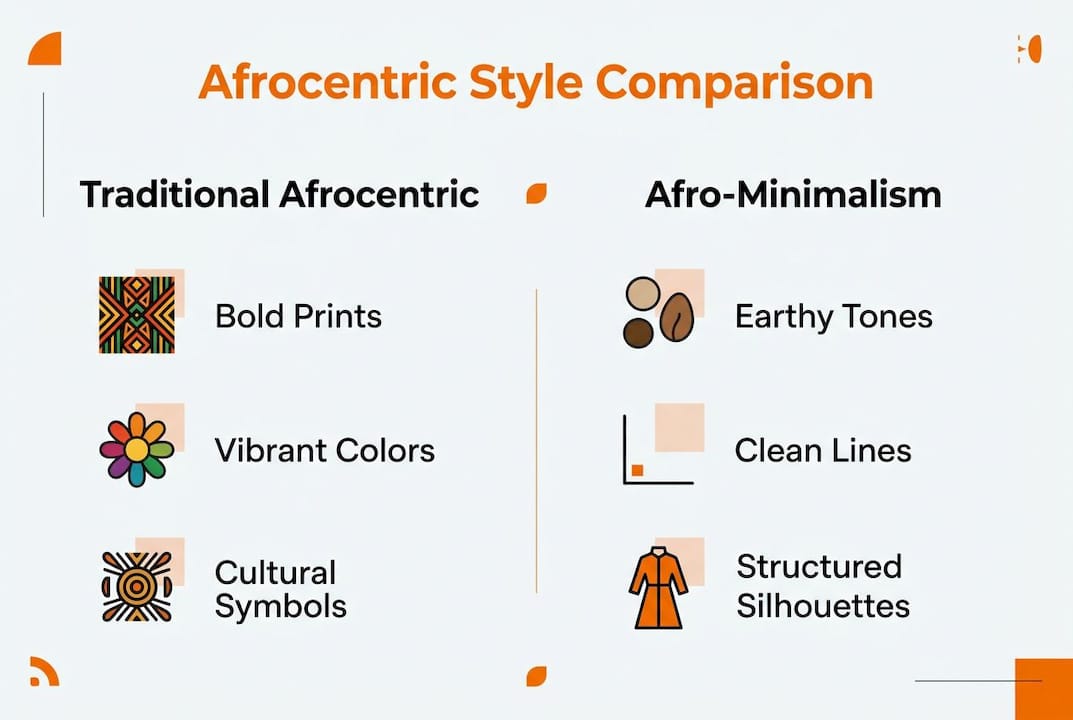
The role of minimalism in Afrocentric style is growing because it aligns with global luxury trends while remaining distinctly African. This is not a compromise. It is a maturation.
What cultural meanings does contemporary Afrocentric fashion convey?
Afrocentric fashion is a medium for storytelling, resilience, history, and hope. Every garment carries a narrative that goes beyond aesthetics. When someone wears a Kente-trimmed jacket or an Ankara print dress, they are making a statement about identity, lineage, and belonging. That statement pushes back against decades of Western fashion norms that excluded or exoticized African aesthetics.
The cultural meanings embedded in contemporary Afrocentric designs include:
- Resilience. Many prints and motifs reference historical resistance, community survival, and collective memory. Wearing them is an act of honoring that history.
- Diaspora identity. For African diaspora communities in the United States, the United Kingdom, and beyond, Afrocentric fashion connects people to a homeland they may never have lived in. It is a physical anchor to cultural identity.
- Empowerment. The movement shifts the narrative from fashion designed for external validation to fashion designed for self-expression. African streetwear blended with traditional fabrics reflects new hybrid identities that are rooted in culture but globally informed.
- Advocacy. Designers and influencers use Afrocentric fashion to challenge colorism, celebrate natural beauty, and demand representation in global media and retail.
- Community. Shared visual language creates belonging. Recognizing a Kente pattern or an Adinkra symbol on a stranger’s clothing creates an instant cultural connection.
The narrative of contemporary African fashion has also shifted internally. Earlier waves of African fashion were often export-oriented, designed to appeal to Western buyers. The current movement designs for African and diaspora communities first, with global appeal as a byproduct rather than a goal.
How do you create youthful Afrocentric outfit combinations?
Building a youthful, wearable Afrocentric wardrobe does not require a full print-on-print approach. The most effective method is strategic balance. Experts recommend pairing one bold heritage item with neutral, high-quality staples to keep the look modern and avoid a costume effect. This approach works for everyday outfits, office-appropriate Afrocentric style, and casual streetwear alike.
Follow these steps to build outfit combinations that feel authentic and current:
- Anchor with one cultural piece. Choose a single item with strong Afrocentric identity: an Ankara print shirt, a Kente-accented cap, or a structured piece inspired by Aso-Oke. This becomes the focal point of the outfit.
- Balance with quality neutrals. Pair your anchor piece with solid-color trousers, a white tee, or a monochrome jacket. Quality fabric matters here. A cheap neutral undermines a strong cultural piece.
- Apply the print-mixing rule. Mixing prints requires pairing a large-scale focal print with a smaller-scale geometric or pinstripe pattern that shares the same color palette. This creates harmony rather than chaos.
- Add Afro-minimalist pieces for versatility. Structured, textured garments in earthy tones work across multiple outfit combinations. A handwoven vest or a pleated wide-leg trouser in a neutral tone can anchor both casual and office-appropriate looks.
- Accessorize with cultural motifs. Beaded jewelry, leather goods with Adinkra stamping, or headwraps in complementary prints add cultural depth without overwhelming the outfit. Keep accessories intentional and limited to two or three pieces.
Pro Tip: For office-appropriate Afrocentric style, choose Afro-minimalist pieces in structured cuts and earthy tones. A tailored blazer in handwoven fabric or a pleated trouser with a subtle geometric weave reads as professional while staying culturally grounded.
Types of Afrocentric everyday outfits range from a Kente-print bomber jacket over a plain white tee and dark jeans to a structured Afro-minimalist dress in a textured neutral fabric. The color blocking tradition in African fashion also offers a strong framework for building bold but cohesive looks without relying on prints alone.
Key Takeaways
Contemporary Afrocentric fashion is defined by the fusion of African cultural heritage with modern design, and Afro-minimalism now leads this movement by expressing identity through structure, texture, and craftsmanship rather than pattern alone.
| Point | Details |
|---|---|
| Core definition | Contemporary Afrocentric fashion fuses African heritage with modern design for everyday cultural expression. |
| Signature fabrics | Kente and Ankara are the most recognized textiles, each carrying deep cultural symbolism beyond decoration. |
| Afro-minimalism | Clean lines, handwoven fabrics, and architectural silhouettes now define the leading edge of this movement. |
| Cultural meaning | Every garment tells a story of resilience, diaspora identity, and empowerment beyond Western fashion norms. |
| Styling rule | Pair one bold cultural anchor piece with quality neutrals and apply scale-based print-mixing for wearable looks. |
Why Afrocentric fashion is the most honest style movement right now
I have watched a lot of fashion movements come and go, and most of them borrow culture without crediting it. Afrocentric fashion does the opposite. It starts with the culture and builds outward. That is rare, and it is why this movement has staying power.
What strikes me most about the Afro-minimalism shift is how it refuses to perform. Earlier waves of African fashion sometimes felt like they were dressing for a Western gaze, proving that African design could be “sophisticated” by Western standards. Afro-minimalism does not ask for that approval. It draws from Yoruba spatial geometry and Babbar Riga silhouettes because those references are correct, not because they are marketable.
The diaspora dimension of this movement also deserves more attention than it gets. For people who grew up between cultures, Afrocentric fashion is not a trend. It is a daily act of self-definition. Wearing a piece from a brand like Afrourbanapparel is not about looking good at a cultural event. It is about building a wardrobe with African roots that shows up every single day.
My honest advice: stop waiting for a special occasion to wear the pieces that mean something to you. The whole point of contemporary Afrocentric fashion is that identity does not take days off.
— Kebz
Afrourbanapparel: premium Afrocentric streetwear for everyday wear
If this article has clarified what contemporary Afrocentric fashion means to you, the next step is wearing it.
Afrourbanapparel builds streetwear that takes the principles covered here seriously: heavyweight fabrics, culturally grounded designs, and silhouettes that work on a Tuesday, not just at a cultural festival. The collections reflect both the bold print tradition and the Afro-minimalist direction, giving you options that fit your personal style without sacrificing cultural authenticity. Every piece is designed for the diaspora individual who wants their heritage present in daily life. Visit Afrourbanapparel’s full collection to find streetwear that carries meaning and holds up to real wear.
FAQ
What does Afrocentric style mean?
Afrocentric style is a fashion approach that centers African cultural heritage, textiles, and symbolism in clothing choices. It is a form of identity expression that affirms African and diaspora pride through everyday dress.
What are examples of contemporary Afrocentric designs?
Contemporary Afrocentric designs include Ankara print bomber jackets, structured blazers inspired by Aso-Oke pleating, Kente-accented streetwear, and Afro-minimalist dresses in handwoven earthy fabrics. These pieces blend traditional African visual language with modern cuts and silhouettes.
What is Afro-minimalism in fashion?
Afro-minimalism is a design philosophy that expresses African identity through clean lines, architectural structure, and textured fabrics rather than bold prints. Designer Tosin Oshinowo defines it as an identity resistance strategy that centers African spatial and cultural contexts.
How do I build office-appropriate Afrocentric outfits?
Choose structured Afro-minimalist pieces in earthy tones or subtle geometric weaves for office settings. A tailored blazer in handwoven fabric or wide-leg trousers with a cultural motif reads as professional while maintaining cultural authenticity.
What fabrics define contemporary Afrocentric fashion?
Kente from Ghana, Ankara from West Africa, Aso-Oke, and handwoven earthy-tone fabrics are the defining textiles of this movement. Each carries cultural symbolism and artisan craftsmanship that mass-produced fabrics cannot replicate.
Recommended
- Modern African Fashion Explained: Culture Meets Style – Afro Urban Apparel
- Color Blocking in African Fashion: Cultural Power and Style – Afro Urban Apparel
- Cultural Fashion Versatility Checklist for Urban Pros – Afro Urban Apparel
- Cultural Fashion Economics Explained for Emerging Designers – Afro Urban Apparel