

A modern dashiki takes the traditional West African tunic and reworks it with tailored cuts, cropped hems, or blazer panels for daily streetwear. Look for medium-to-heavy cotton, a tailored or fitted silhouette, and pair it with slim bottoms rather than baggy ones. Some brands build these pieces specifically for that everyday, heritage-forward look rather than ceremonial wear.
TL;DR:
- High-quality modern dashikis use medium to heavy cotton with dense weave and reinforced seams to ensure durability over time.
- Styling reduces volume by pairing loose tops with fitted bottoms, layering with neutral pieces, and keeping accessories minimal to highlight the print.
- Major design features include asymmetrical hems, cropped lengths, tailored side seams, and blazer panels, often inspired by contemporary tailoring trends.
- Proper care involves washing in cold water on a gentle cycle, line drying in the shade, and avoiding bleach to preserve colorfastness and fabric integrity.
- Authentic pieces reveal dye penetration through the fabric and dense construction, while cheap knockoffs tend to be lightweight, surface-printed, and have loose embroidery.
Table of Contents
- What Does a Modern Dashiki Look Like Today?
- How Do You Style a Modern Dashiki for Everyday Wear?
- What Should You Check Before Buying a Modern Dashiki?
- How Do You Wash and Care for a Dashiki Without Ruining the Print?
- What Should You Wear a Modern Dashiki With by Season?
- How Can You Tell a Genuine Modern Dashiki From a Cheap Knockoff?
- How Do You Mix a Modern Dashiki Into a Regular Wardrobe?
- Afro Urban Apparel’s Take on Heritage-Driven Streetwear
- See Afro Urban Apparel’s Modern Dashiki Collection
- Sources
- FAQ
What Does a Modern Dashiki Look Like Today?
The traditional dashiki is a colorful tunic with a distinctive v-neck embroidered collar and bold printed patterns, a form documented across West African clothing traditions. The modern version keeps that collar and print energy but changes almost everything else about the cut.
You’ll find four style families dominating racks right now. Loose tunics stay closest to the original silhouette, best for readers who want comfort and a strong cultural statement without much tailoring. Tailored shirts bring in fitted seams and a slimmer sleeve, so the piece reads as a shirt you’d wear to a dinner rather than a costume piece. Cropped tops and coordinated two-piece sets have grown fast, especially among younger shoppers who want the print without the volume. And you’ll increasingly see dashiki panels worked into blazers and jackets, a fusion trend that designers and retailers are pushing hard into 2026.
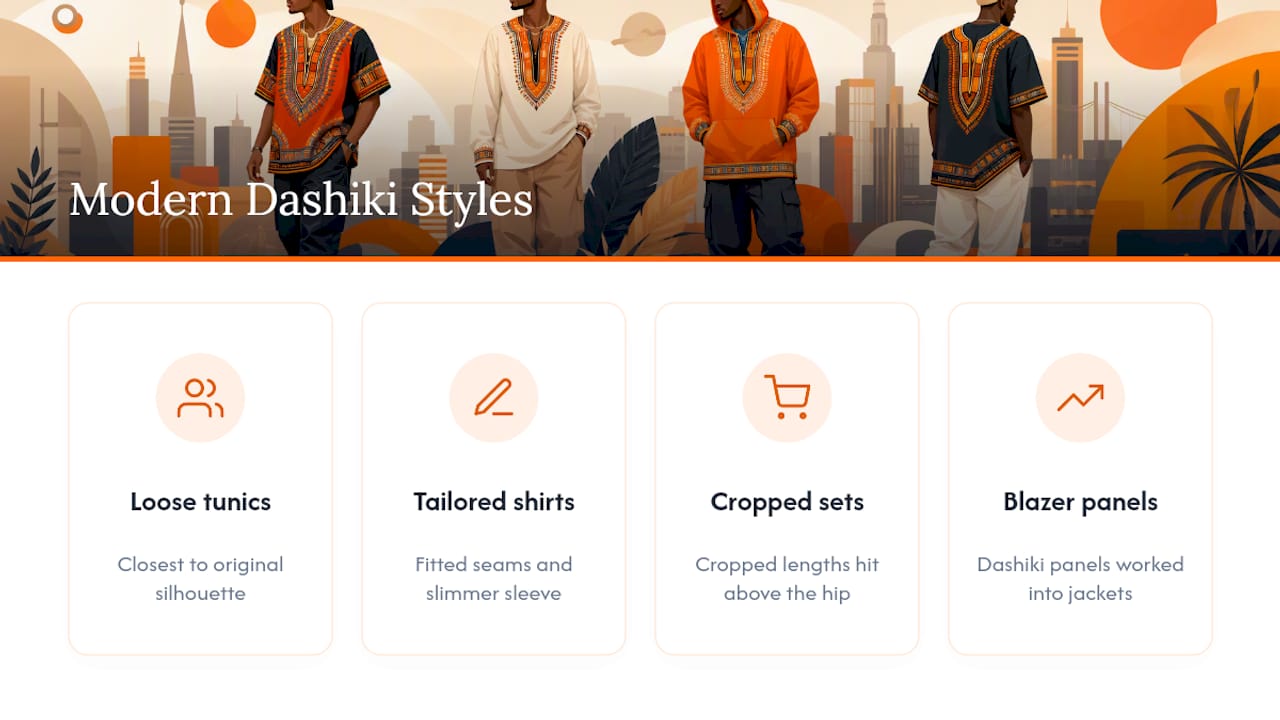
The design signals to watch for: asymmetrical hems, slimmer sleeve construction, tailored side seams that nip in at the waist, and cropped lengths that hit above the hip. Designers now treat the dashiki as a canvas for contemporary tailoring rather than a fixed template, which is exactly why the asymmetrical hem and blazer panel have become such common details.
There’s also a construction tell that separates everyday wear from ceremonial pieces. Garments meant for daily rotation use heavier, denser cotton with reinforced seams and finished hems. Ceremonial dashikis often prioritize drape and volume over durability, since they’re worn occasionally, not washed weekly.
How Do You Style a Modern Dashiki for Everyday Wear?
Volume is the biggest styling trap. A loose dashiki paired with equally loose pants reads as a costume. Fashion coverage consistently points to the same fix: balance the garment’s volume with fitted bottoms and keep accessories minimal so the print stays the focal point.
Here’s how that plays out across three registers:
- Daytime casual: high-waisted jeans or slim chinos, a half-tuck to define your waist, sneakers or loafers on your feet.
- Cold weather: a neutral crew-neck tee or hoodie layered underneath, which adds warmth and urban texture while still showing off the embroidered collar.
- Smart-casual evenings: slim tailored trousers, a denim or unstructured blazer over the dashiki, and block heels or boots instead of sneakers.
- Semi-formal settings: stick to grounded footwear and restrained jewelry so nothing competes visually with the print.
If a piece runs a little loose through the body or sleeves, a tailor can taper the sleeves and take in the side seams in under an hour. That single fix often does more to modernize the look than any accessory choice. Gender-neutral styling works well here too. Wide-leg trousers or a longer, boxier cut suit anyone, and the same coordinated set can be dressed up or down depending on footwear alone.
Pro Tip: Half-tuck the front of the dashiki into your waistband and leave the back loose. It creates shape without losing the drape that makes the print pop.
What Should You Check Before Buying a Modern Dashiki?
Fabric weight tells you almost everything about how a dashiki will wear over time. High-quality pieces use heavier cotton and stable reactive dyes for better colorfastness, typically landing in a medium to heavy cotton weight range that gives the fabric structure instead of a flimsy, see-through hang. Linen blends and silk show up in dressier pieces, but they trade durability for drape.
Before you buy, run through this checklist:
- Print quality: hold the fabric to light. A print that penetrates through to the back reads as higher quality than one that’s only surface-printed on lightweight cotton.
- Fit and sizing: measure your chest and preferred garment length; size up slightly if you plan to layer underneath, size true-to-body for a streamlined silhouette.
- Seams and hems: finished, reinforced seams signal a piece built for regular washing, not occasional wear.
- Price band: cheap market prints often run at the bottom of the price range and fade fast; mid-range tailored pieces cost more but hold shape and color longer; premium artisan-made dashikis sit at the top and usually justify the price with hand-finished detailing.
A piece that feels stiff and papery in-store rarely softens into something you’ll want to wear weekly.
How Do You Wash and Care for a Dashiki Without Ruining the Print?
Wash cold on the gentle cycle, and wash new pieces separately for the first three washes to catch any dye bleed before it touches your other clothes. Skip the dryer’s high heat setting entirely. Line dry in the shade instead. Direct sun fades bold prints faster than almost anything else you’ll do to the garment.
Bleach is off the table, full stop. It strips reactive dyes and leaves blotchy patches that no amount of careful washing afterward will fix. When you iron, do it while the fabric is still slightly damp and keep the iron on medium heat. This helps the embroidered collar lie flat without scorching the print underneath.
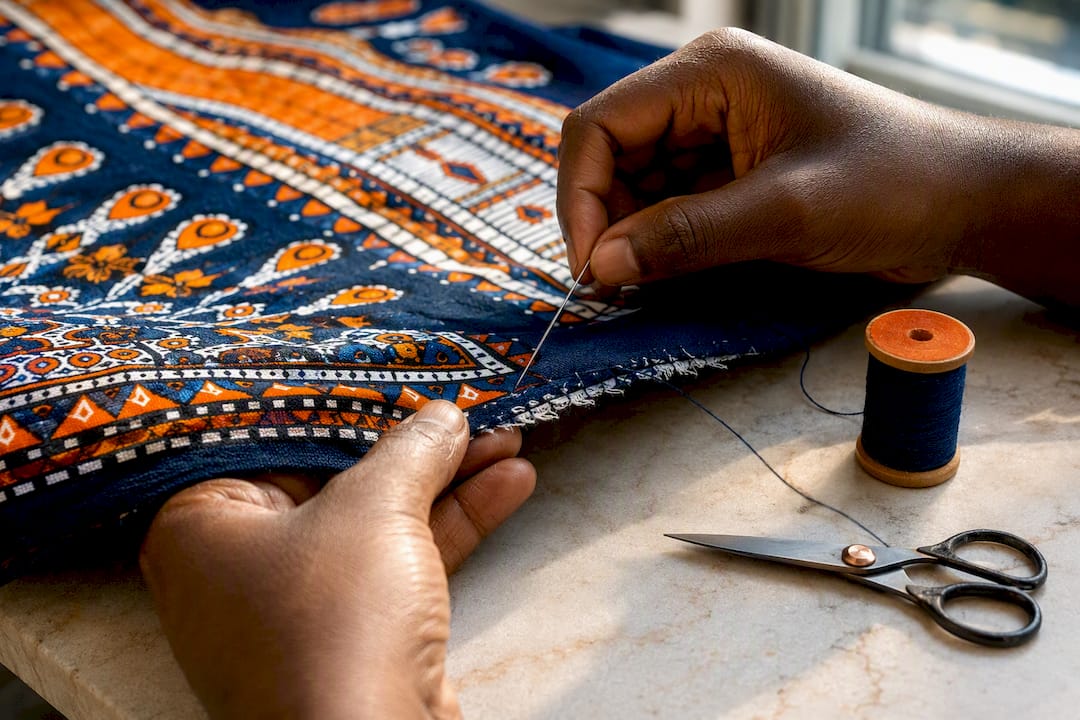
If a hem starts to fray or a seam pulls loose, get it repaired quickly. A quick stitch job keeps the print pattern aligned at the seams, and once a hem unravels past a certain point, it’s much harder for a tailor to match the original pattern line.
What Should You Wear a Modern Dashiki With by Season?
Warm-weather months are the easiest fit. A lightweight to mid-weight cotton dashiki works on its own with slim shorts or rolled chinos, and the loose cut actually helps with airflow in heat. This is where the traditional silhouette and the modern one overlap most.
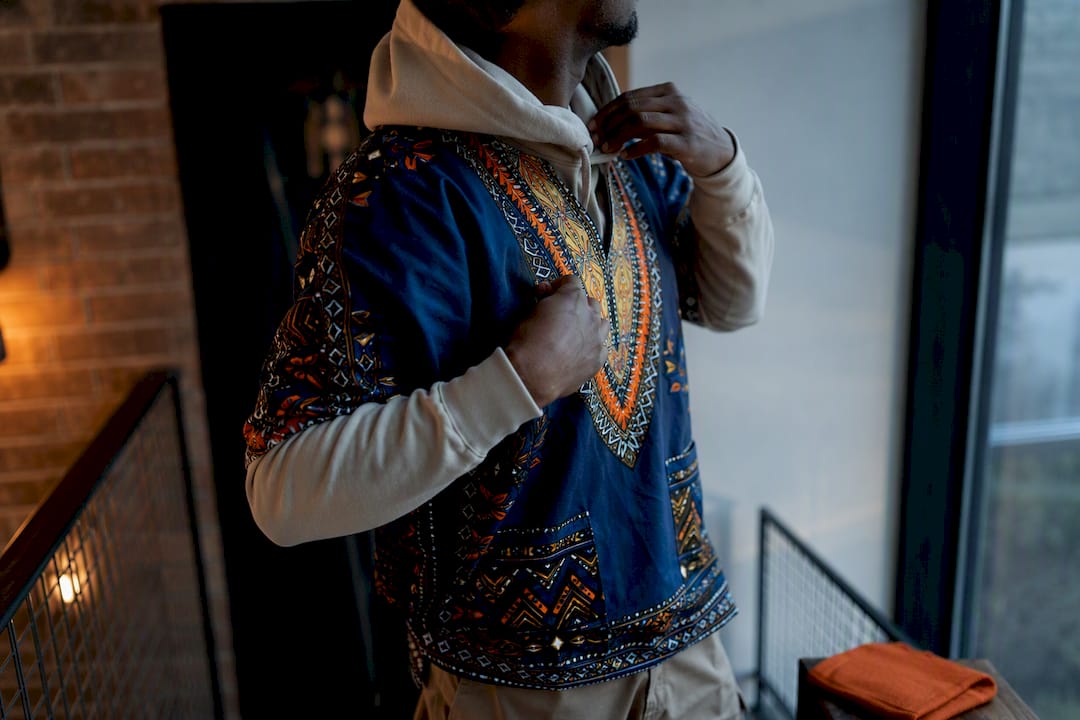
Cooler months need a layering strategy. A neutral crew-neck tee or a hoodie underneath preserves the signature collar while adding real warmth, and it gives the outfit an urban texture that reads as intentional rather than mismatched. A denim jacket or an unstructured blazer over the top extends that into early winter without hiding the print entirely, since you can leave it open.
Humidity and rainy seasons are where fabric choice matters most. Heavier cotton holds up better against repeated damp handling than linen blends, which tend to wrinkle and lose shape after a few humid days. If you’re buying one piece to wear across most of the year, a medium-heavy cotton tunic or tailored shirt is the safer call over a delicate silk-blend version that’s really built for one season.
Layering underneath also solves a practical problem: it lets a single dashiki piece move from a 60-degree evening to a 40-degree one without needing a second wardrobe. That versatility is part of why the cropped and tailored versions have caught on faster than the loose traditional cut for year-round wear.
How Can You Tell a Genuine Modern Dashiki From a Cheap Knockoff?
Print penetration is the fastest test. Flip the fabric over. A genuine, well-made piece shows the pattern bleeding through to the reverse side, while a cheap imitation typically shows only a faint outline or nothing at all on the back. That’s the difference between a dye that’s been properly set into the fiber and a print that’s essentially sitting on the surface.
Weight is the second giveaway. Pick the garment up. Lightweight, see-through cotton that feels papery is almost always a mass-market imitation built for a quick sale, not for regular wear. Genuine modern pieces use denser cotton that has some heft and drape without being stiff.
Check the embroidery on the collar too, if the piece has one. Hand-finished or tightly stitched embroidery holds its shape after washing. Loose, machine-chained stitching on cheap versions tends to pucker or unravel within a few washes.
Finally, look at how the brand talks about its own construction. A retailer that specifies fabric weight, dye process, or construction details is generally more transparent than one selling on the print alone with no fabric information listed. Vague listings with stock photos and no fabric specifics are a common pattern among low-quality imitations flooding marketplace sites.
How Do You Mix a Modern Dashiki Into a Regular Wardrobe?
Treat the dashiki as your statement piece and let everything else go quiet. Denim is the easiest anchor. Slim or straight-leg jeans in a dark wash pull the print into everyday territory instantly, and they’re forgiving with both tailored and loose cuts.
Neutral layering pieces do a lot of work here too. A plain white tee under an open dashiki shirt, or a tailored blazer over a cropped version, turns the outfit smart-casual without touching the print itself. For readers experimenting with asymmetrical hems or unusual paneling, looking at how other categories of clothing handle asymmetrical and ruffled design details can offer proportion ideas worth borrowing.
Accessories should stay in a supporting role. One statement piece, whether it’s a watch, a simple chain, or a structured bag, is usually enough. Piling on beaded jewelry or a second bold pattern competes with the print instead of complementing it. If you want more direction on pairing pieces without overthinking it, designer accessory styling guidance covers the basics of restraint that apply directly here.
Footwear is where a lot of outfits either click or fall apart. Sneakers keep things casual and youthful. Loafers or boots shift the same outfit toward smart-casual without changing a single other piece.
Afro Urban Apparel’s Take on Heritage-Driven Streetwear
Some brands design around one core idea: identity shouldn’t be reserved for special occasions. That shapes every fabric and construction decision. Some pieces use heavyweight cotton for durability and structure, not just print vibrancy, and cultural motifs may be placed deliberately so they read as design, not decoration on a blank shirt.
That approach lines up directly with the buying criteria covered earlier. Heavier cotton can mean better colorfastness through repeated washing. Tailored construction may make the piece work as daily wear, not a special-occasion costume. Buyers often point to fabric quality and fit as standout features, aligning with a brand philosophy of wearing heritage every day rather than once a year.
— Kebz
See Afro Urban Apparel’s Modern Dashiki Collection
Some brands offer heavyweight streetwear shirts, coordinated sets, and dashiki-inspired pieces cut for daily rotation instead of one-time wear. This can help you avoid marketplace listings with no fabric specifics or vague print quality claims.
Catalogs may include tailored streetwear shirts with embroidered collar detailing, coordinated sets for a put-together look, and heavyweight hoodies with cultural print panels. Many pieces match the checklist covered above: medium-to-heavy cotton for structure, tailored cuts that avoid the costume look, and prints designed for durability with regular washing rather than fading quickly.
If you’re ready to build a wardrobe around pieces meant for daily wear, browse the full collection at Afro Urban Apparel and check current sizing and fit notes on each product page before you order.
Sources
For heritage context, see the Wikipedia entry on dashiki origins and its Spanish-language counterpart. For deeper design philosophy, read how traditional patterns adapt into modern collections.
FAQ
What Is a Dashiki?
A dashiki is a colorful tunic-style garment originating in West Africa, identified by its v-neck embroidered collar and bold printed patterns.
What Is African Clothing for Men Called?
Men’s traditional African garments go by many regional names, but the dashiki is one of the most widely recognized tunic styles worn across West Africa and its diaspora.
How Does a Modern Dashiki Differ From a Traditional One?
A modern dashiki keeps the traditional print and collar but adds tailored seams, cropped lengths, asymmetrical hems, or blazer panels, cuts designed for everyday streetwear rather than ceremonial use.
Where Can You Buy a High-Quality Modern Dashiki?
Look for brands that specify fabric weight and construction details rather than selling on print alone. Afro Urban Apparel offers heavyweight cotton pieces built specifically for daily wear.
How Much Should a Modern Dashiki Cost?
Prices vary by construction quality. Low-cost market prints sit at the bottom of the range, mid-range tailored pieces cost more but hold color and shape longer, and premium artisan-made pieces sit at the top with hand-finished detailing.