

Ankara is a wax-resist printed cotton from West Africa, stiff enough to hold structure in jackets and tailored skirts, while kitenge is a directly printed cotton from East and Central Africa, softer and better suited to wraps and flowy dresses. The fastest way to tell them apart in a shop: flip the fabric over. If the color looks nearly as strong on the back as the front, you’re likely holding Ankara.
TL;DR:
- Flipping the fabric over is the quickest way to distinguish Ankara from kitenge, with Ankara showing nearly even color on both sides.
- Ankara is heavier, stiffer, and wax-resist printed, making it ideal for structured garments that need to hold shape.
- Kitenge is lighter, softer, and directly printed, suited for flowing dresses, wraps, and everyday utility clothing.
- Price differences stem from production methods: wax-resist printing takes longer and costs more than direct printing, regardless of regional name.
- Accurate fabric choice depends on garment function, with structured pieces favoring Ankara and drapey designs better suited to kitenge.
Table of Contents
- Kitenge vs Ankara at a Glance: Origin, Printing, and How to Check
- Ankara in Depth: Technical Traits, Quality Cues, and Tailoring Notes
- Kitenge in Depth: Regional Context, Printing Methods, and Practical Uses
- How to Choose Between Kitenge and Ankara for Your Project
- Kente, Khanga, and Shweshwe: Fabrics Often Mixed Up With Kitenge and Ankara
- Afro Urban Apparel’s Take: Fabric Choice Is Identity, Not Just Style
- The Real Difference Nobody Explains Clearly Enough
- Sources
Kitenge vs Ankara at a Glance: Origin, Printing, and How to Check
The two fabrics come from different regions, get printed by different methods, and behave differently once you cut into them. Knowing all three makes shopping and sewing decisions much faster.
Ankara traces back to West Africa, particularly Nigeria and Ghana, where it became a staple of both everyday and formal dress. Kitenge belongs to East and Central Africa, worn across Kenya, Tanzania, Uganda, and neighboring countries, sometimes under the names chitenge or vitenge depending on the country. That regional split is the fastest mental shortcut: West African markets and diaspora shops lean Ankara, East African ones lean kitenge.
The production method explains almost everything else. Ankara uses wax-resist printing, where melted wax blocks dye from penetrating certain areas of the cloth, creating a print that reads with similar intensity on both sides. Kitenge typically goes through direct, roller, or screen printing, a faster and cheaper process that pushes dye through from one side only, leaving the back noticeably paler.
Weight and hand follow the same logic. Ankara feels heavier and holds a crease, which is why tailors reach for it when a garment needs to keep its shape. Kitenge moves more freely and drapes closer to the body.
A few checks separate the two quickly:
- Flip the cloth. Even color front and back usually signals Ankara; a faded back usually signals kitenge.
- Feel the hand. Stiff and slightly waxy points to Ankara; soft and cottony points to kitenge.
- Look for a border. Many kitenge pieces carry an edging strip along one long side, sometimes with Swahili text in coastal varieties, a feature Ankara rarely has.
- Check the price tag. Wax prints generally cost more per yard than direct prints because the process takes longer and uses more dye.
Ankara in Depth: Technical Traits, Quality Cues, and Tailoring Notes
Ankara grew into a cultural signature across Nigeria, Ghana, and the wider West African diaspora, worn at weddings, church services, and increasingly in streetwear collections that mix tradition with modern cuts. The fabric’s identity is inseparable from its production method.
Wax-resist printing applies hot wax to cotton in patterned blocks before dyeing, then repeats the process for each additional color. The wax stops dye from soaking through evenly, but because it’s applied so precisely, the resulting print looks nearly identical on both faces of the fabric. That’s the trait most buyers use to spot genuine wax prints, and it’s also what gives Ankara its slightly stiff, almost waxy hand even after the literal wax is washed out during finishing.
That stiffness is a feature, not a flaw, for certain garments. Structured jackets, tailored pencil skirts, fitted bodices, and anything that needs to hold a silhouette without a lining benefits from Ankara’s body. Softer garments can still work, but the fabric won’t fall the way a lighter cotton would.
A few quality checks worth running before you buy:
- Hold the cloth to light and check whether the pattern lines up cleanly on both sides.
- Rub a damp finger on an inconspicuous corner. Heavy dye transfer suggests a lower-grade print.
- Check the selvage edge for a printed brand name or roller number, which often indicates a factory-grade wax print rather than an imitation.
Pro Tip: Wash new Ankara in cold water alone for the first two cycles. Even well-set wax prints can bleed slightly, and you don’t want that dye landing on anything else in the load.
Care after that first wash is straightforward: machine wash cold, skip the dryer’s high heat, and iron on the reverse side to protect the surface color.
Kitenge in Depth: Regional Context, Printing Methods, and Practical Uses
Kitenge carries its own identity across East and Central Africa, showing up in daily wear, celebrations, and baby-carrying wraps under names like chitenge in Zambia and Malawi, or vitenge as the plural form in Swahili-speaking regions. It sits in the same broad fabric family as kanga, though kitenge runs thicker and typically skips the printed text that kangas almost always carry.
Production usually relies on direct, roller, or screen printing rather than wax-resist. Dye gets applied straight to one face of the cotton, which keeps costs down and speeds up manufacturing, but leaves a visibly lighter print on the reverse side. That’s not a defect. It’s simply a different process built for a different end use, and it produces the softer hand that makes kitenge so comfortable against skin.
Many kitenge pieces include a border running along one long edge, a design holdover from the fabric’s use as a wrap that needs a finished-looking edge without hemming. Coastal East African varieties sometimes weave in Swahili proverbs along that border, a detail worth checking if you’re trying to confirm regional origin.
The lighter weight and looser drape make kitenge a natural fit for:
- Wraps and headwraps that need to tie and fold without bulk.
- Flowy maxi dresses and skirts that move with the body.
- Loose tops and dashiki-style shirts worn in warmer climates.
- Baby slings and everyday utility cloths, a traditional use that predates fashion entirely.
Laundering kitenge is gentler work than caring for Ankara. Cold wash, mild detergent, and air drying keep the softer weave from thinning out prematurely, since the lighter fabric shows wear faster than a heavier wax print would.
How to Choose Between Kitenge and Ankara for Your Project
Pick based on what the garment needs to do, not which fabric looks better on the bolt. Structure and drape are the two questions that matter most.
- Ask if the garment needs to hold shape. A blazer, structured skirt, or fitted bodice wants Ankara’s stiffness. A dress meant to swing and move wants kitenge.
- Match motif scale to your frame and the garment size. Larger prints suit bigger silhouettes and taller wearers; smaller, denser patterns work better on fitted pieces or petite frames.
- Factor in climate. Ankara’s density traps a bit more heat, which matters for anyone sewing for a hot, humid setting where kitenge’s lighter hand breathes better.
- Weigh your sewing skill against the fabric. Kitenge’s soft drape is more forgiving for beginners working with flowy patterns. Ankara’s stiffness helps hide construction flaws in structured pieces but punishes loose seams.
- Decide how much authenticity matters for the price. A hand-quality wax print costs more but holds color and shape longer, which is worth it for pieces meant to last years rather than one season.
| Project | Better fabric | Why |
|---|---|---|
| Tailored jacket or blazer | Ankara | Holds structure without heavy interfacing |
| Lined pencil skirt | Ankara | Stiffness supports a clean silhouette |
| Flowy summer dress | Kitenge | Soft drape moves with the body |
| Headwrap or gele | Kitenge | Lightweight, ties and folds easily |
| Statement accessory or bag | Ankara | Durable hand withstands daily handling |
Before buying, run a short checklist: measure the yardage against your pattern, feel the hand for stiffness versus softness, check the back for print clarity, and ask the seller directly whether the piece is wax printed or direct printed. Sellers who know their stock will answer without hesitation. For more on how print scale interacts with garment shape, a style guide on tropical print fashion covers pattern selection in more general terms worth cross-referencing.
Kente, Khanga, and Shweshwe: Fabrics Often Mixed Up With Kitenge and Ankara
Three other textiles get lumped into the Ankara and kitenge conversation constantly, and they shouldn’t be.
Kente isn’t printed at all. It’s hand-woven from interlaced silk and cotton strips by the Ashanti people, carrying deep ceremonial weight that a printed cotton simply can’t replicate. If the cloth has woven geometric strips rather than a printed surface pattern, it’s Kente, not a wax print.
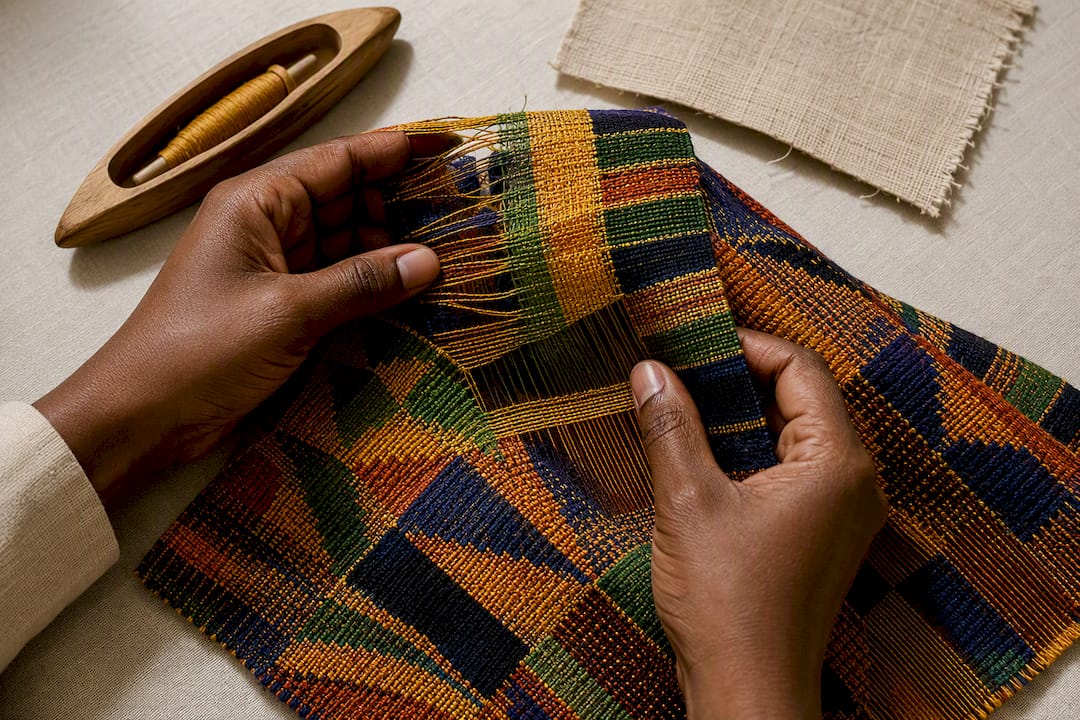
Khanga (also spelled kanga) is kitenge’s lighter cousin. It’s thinner, almost always carries printed Swahili proverbs across the design, and is used more for everyday wrapping than kitenge’s slightly heavier, border-edged cloth.
Shweshwe belongs to southern Africa, historically indigo-dyed with tight geometric roller-printed patterns and a distinctive starchy finish you can feel the moment you touch it. That stiff, almost paper-like hand right off the bolt is the giveaway that separates real shweshwe from imitations sold under the same name.
Afro Urban Apparel’s Take: Fabric Choice Is Identity, Not Just Style
Some streetwear brands build around the idea that heritage belongs in daily rotation, not just special occasions. That philosophy shapes material choices directly: heavier wax-inspired prints hold up to everyday wear the way a lighter cotton can’t, which is why structured pieces lean toward Ankara-weight fabric while softer graphic tees use more breathable cotton blends.
Durability matters as much as pattern accuracy when a hoodie gets worn weekly instead of once a year. For readers building a wardrobe around these prints, Afrourbanapparel’s guide to Ankara in streetwear and its breakdown of modern African fashion go deeper into how tradition and everyday design intersect.
Ready to see these fabric principles applied to actual pieces? Browse Afro Urban Apparel’s current collection for heavyweight streetwear built with the same durability logic covered here, or visit the Afro Urban Apparel homepage to explore the full range of culturally rooted apparel made for daily wear.
The Real Difference Nobody Explains Clearly Enough
Most comparisons treat Ankara and kitenge like rival products competing for the same job, and that framing misses the point entirely. They were never built to do the same thing. Ankara was shaped by a printing process designed for structure and permanence. Kitenge grew out of a need for something light enough to wrap, carry, and move in through equatorial heat. Neither is the “better” fabric because they’re solving different problems.
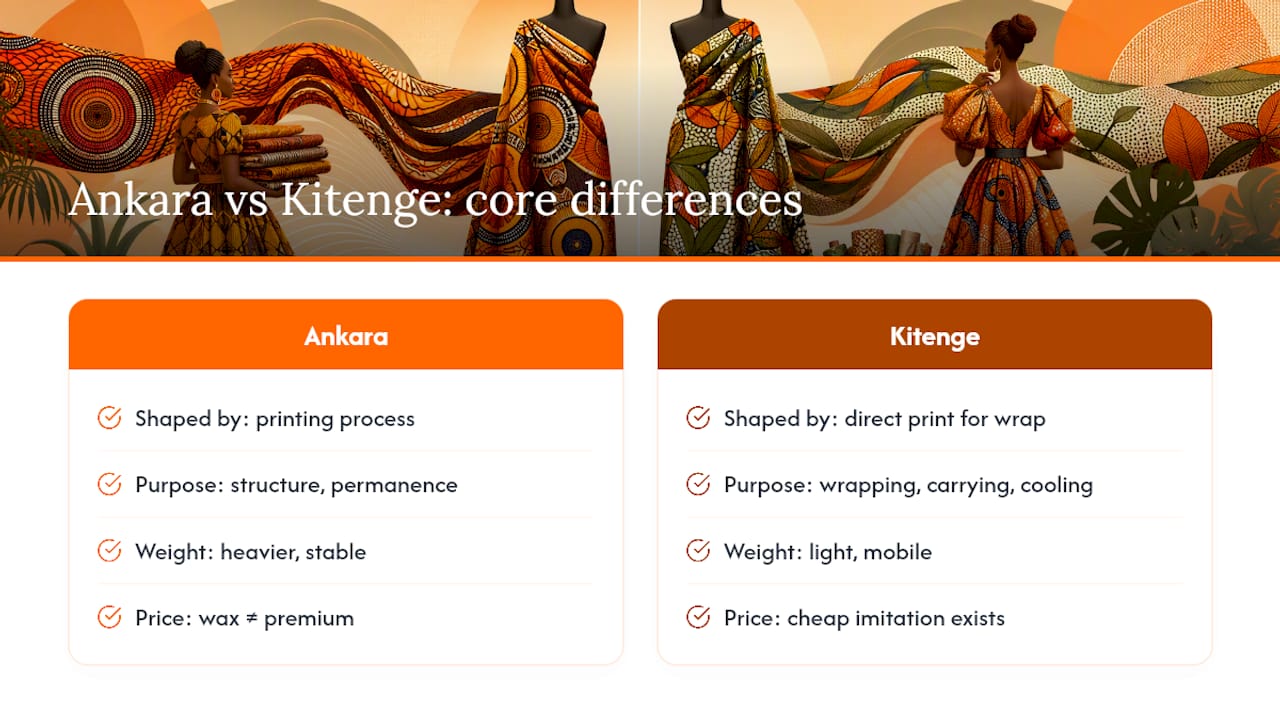
What actually trips people up is treating price as a proxy for authenticity. A cheap wax print imitation can cost less than a well-made direct-printed kitenge, yet plenty of buyers assume “wax equals premium” and skip the back-of-fabric check that would tell them the truth in five seconds. That single habit, flipping the cloth over before buying, does more to protect against disappointment than any amount of brand-name shopping.
The other overlooked piece: regional identity isn’t decoration, it’s information. A border with Swahili script on a kitenge, or a specific wax pattern tied to a West African textile house, tells you where a cloth’s design lineage actually sits. Treating every colorful African print as interchangeable erases that context, and it’s exactly the kind of flattening that diaspora shoppers are usually trying to push back against when they choose these fabrics in the first place.
— Kebz
Sources
- Cloth of a continent: Africa and fashion | V&A
- Kitenge — Wikipedia
- How to choose African Ankara & Kitenge dresses — Alibaba Apparel guide
- All hail shweshwe: The history and rebirth of an iconic fabric — News24