

African textile traditions are defined as sophisticated visual languages that communicate cultural identity, history, and social values through weaving, dyeing, and symbolic pattern-making. These are not decorative arts in the Western sense. They are primary historical documents, coded communication systems, and living archives that predate written records across much of the continent. Understanding African textile traditions explained through this lens transforms how you read a piece of cloth. Techniques like strip-weaving, resist dyeing, and embroidery each carry grammar rules as strict as any spoken language, and the colors, patterns, and materials chosen are never arbitrary.
What are the key African textile weaving techniques explained?
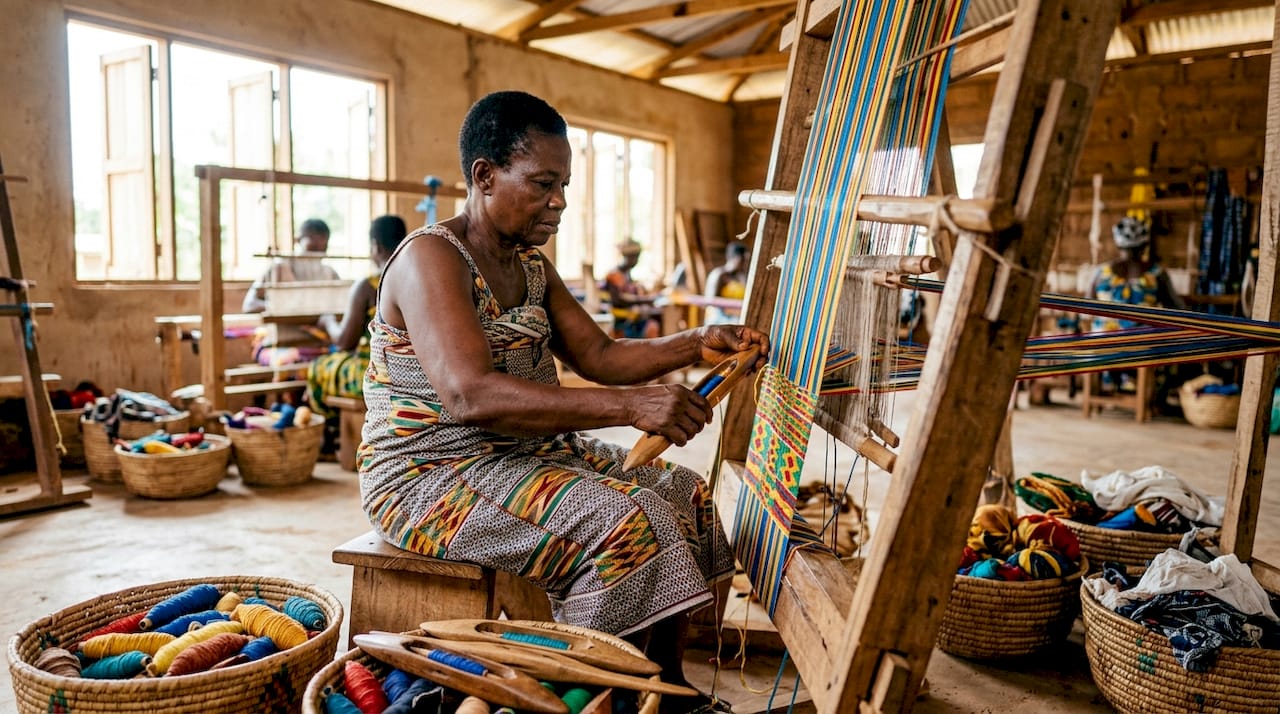
Strip-weaving is the foundational technique of West African textile production. Strip-weaving dates back to at least the 11th century, originating with the Mande and Tellem peoples of present-day Mali. The method produces narrow strips, typically about 4 inches wide on traditional horizontal looms, which are then sewn edge-to-edge to create a full cloth. The seams are intentional design features, not flaws. They add movement and visual rhythm to the finished fabric.
Two major traditions within strip-weaving show how much regional variation exists within a single technique:
- Asante weaving uses a horizontal treadle loom operated exclusively by men. Asante weavers work with silk and cotton, producing the famous Kente cloth. The heddle system they use allows for complex color changes within each strip.
- Ewe weaving also uses the horizontal loom but employs a different heddle configuration, which affects design complexity and the range of symbolic meanings a weaver can encode. Ewe cloth tends to feature pictorial motifs alongside geometric ones.
- Raffia weaving among the Kuba people of the Democratic Republic of Congo uses palm fiber rather than cotton or silk. The resulting fabric has a dense, velvety texture achieved through cut-pile embroidery applied after weaving.
- Resist dyeing is a separate but equally important technique. Yoruba women practice Adire, a method where fabric is tied, stitched, or starch-pasted before immersion in indigo dye. Each method of resistance creates a different pattern vocabulary.
Materials shape meaning as much as technique does. Cotton, silk, raffia, and locally sourced plant fibers each carry their own cultural weight. Silk in Asante Kente historically signaled royal status because silk was rare and expensive. Raffia in Kuba cloth signals connection to the forest and ancestral land.
Pro Tip: When examining a strip-woven cloth, count the strips and measure their width. Narrower strips require more skill and time, and a cloth with many narrow strips often signals higher craftsmanship and greater cultural investment.
The division of labor in textile production is itself culturally encoded. Among the Asante, weaving is men’s work and dyeing is women’s work. Among the Yoruba, Adire production is entirely women’s domain, with knowledge passed directly from mother to daughter across generations.
How does color play a symbolic role in African textiles?
Color in African textiles is not aesthetic preference. It is a standardized communication code. Traditional African textile colors carry fixed cultural meanings that are consistent across major West African traditions, particularly among the Asante. Gold signals royalty and wealth. Green represents fertility and renewal. Blue carries spiritual meaning and connection to the divine. Black references ancestors and the spiritual realm of the dead.
These meanings compound when colors appear together. A cloth combining gold and black in Asante tradition does not simply look striking. It makes a statement about the wearer’s connection to both royal authority and ancestral power. Reading that statement requires cultural literacy, not just visual attention. The role of color in African textiles functions the way syntax functions in language: the arrangement changes the meaning.
Specific textiles demonstrate this clearly:
- Kente cloth uses gold, green, and black in named pattern combinations. Each named pattern references a specific proverb or historical event. The color choice reinforces or extends that reference.
- Bogolan mudcloth from Mali works in earth tones, particularly deep brown and cream. The contrast between the fermented mud-painted areas and the undyed ground creates the symbolic field where patterns carry meaning.
- Adire from Yoruba tradition relies on indigo blue as its primary color. The depth of the blue and the complexity of the resist pattern together signal the skill level of the maker and the importance of the occasion.
Color also marks life stages. Among the Yoruba, specific color combinations signal mourning, celebration, initiation, or marriage. Wearing the wrong color combination at a ceremony is not a fashion mistake. It is a social statement, and community members read it as such.
What are examples of high-quality traditional African textiles?
The most recognized examples of high-quality African textiles each represent a distinct technical tradition and a distinct cultural grammar.
Kente cloth is the most globally recognized African textile. Kente is woven in narrow strips on horizontal looms, with each named pattern representing a proverb or historical statement. The cloth functions as a visual language understood by community insiders. A pattern called “Oyokoman” references the Asante royal family. “Emaa Da” translates roughly as “it has not happened before,” marking unprecedented achievement. Wearing Kente without knowing its pattern names is like quoting a text you have never read. Ghana secured geographical indication protection for Kente cloth in 2025, a legal recognition that authentic Kente must come from specific weaving communities. That protection matters because it ties the cloth’s meaning to its origin.
Bogolan mudcloth from Mali uses a production process unlike any other textile tradition. Women traditionally paint patterns onto strips that men have woven, using fermented mud and plant mordants to fix color. The patterns encode community myths, hunting histories, and protective symbols. Bogolan was historically worn by hunters and new mothers, both groups understood to be in liminal states requiring spiritual protection.
Adire from the Yoruba people of Nigeria demonstrates the depth of resist-dye technique. Adire uses multiple resist methods including tied fabric, stitched patterns, and cassava starch paste applied through stencils. Each method produces a different visual grammar. The pictorial grids found in Adire Eleko, the starch-paste variety, reference Yoruba cosmology, daily life, and historical events in a format that trained readers can interpret panel by panel.
Kuba raffia cloth from the Democratic Republic of Congo uses geometric patterns that function as clan identifiers. The cut-pile embroidery technique produces a texture that photographs cannot fully capture. Physical contact with the cloth is part of its cultural experience.
Pro Tip: When assessing the quality of a traditional African textile, look at the back of the cloth. In high-quality Kente and Adire, the reverse side shows the same level of care as the front. Shortcuts in production show up immediately on the reverse.
How do African textiles function as historical documents?
African textiles are primary historical sources in the same way that written chronicles are primary sources in other traditions. Textiles memorialize political events, social values, and personal biographies through symbolic language that trained readers can decode. This reframes what a museum textile collection actually contains. It is not a collection of beautiful objects. It is an archive.
The historical function of textiles operates on several levels:
- Event commemoration: Specific Kente patterns were created to mark coronations, military victories, and diplomatic events. The pattern name records the event, and the cloth becomes a durable record.
- Social rank encoding: The complexity and material quality of a cloth signals the wearer’s status. A chief’s cloth uses more strips, finer materials, and more complex named patterns than a commoner’s cloth.
- Rite of passage documentation: Initiation, marriage, and mourning each require specific textiles. The cloth worn marks the transition and becomes part of the individual’s personal history.
- Political messaging: Kanga textiles in East Africa carry printed proverbs called “jina” that function as direct public statements. A Kanga without a meaningful message loses its cultural function entirely.
- Diaspora identity assertion: African textiles in diaspora communities serve as declarations of cultural continuity. Wearing them is a public statement about belonging and memory.
“Reading African textiles requires learning their complex grammar and symbolism, without which the cloth loses meaning and reduces to mere decoration or commodity. African textiles should be understood as text, where weaving and dyeing form a public, readable declaration, redefining literacy beyond Western paradigms.”
African textile designs provoke measurable cognitive and emotional responses through symmetry, symbolism, and cultural resonance, particularly in diaspora communities. This is not sentiment. It is a documented psychological experience linked to identity and memory. The cloth carries information that the body recognizes before the mind articulates it.
The challenge of cultural misappropriation enters here. The fashion industry often flattens African textile traditions into aesthetic choices, ignoring strict rules about who may wear specific cloths and their social weight. Using Kente as a generic “African print” erases the specific proverbs, histories, and community protocols embedded in each named pattern.
Key Takeaways
African textile traditions are coded languages, not decorative arts, and reading them requires learning their grammar of technique, color, and pattern.
| Point | Details |
|---|---|
| Strip-weaving is foundational | West African strip-weaving dates to the 11th century and encodes meaning through material, width, and pattern. |
| Color carries fixed meaning | Gold, green, blue, and black carry standardized cultural codes consistent across major West African traditions. |
| Each textile type has its own grammar | Kente, Bogolan, Adire, and Kuba cloth each use distinct techniques and symbolic systems that require cultural literacy to read. |
| Textiles are historical archives | African cloths memorialize events, social rank, and rites of passage in ways that parallel written chronicles. |
| Misappropriation erases meaning | Using African textiles without understanding their grammar reduces complex cultural documents to surface decoration. |
Why I think most people are reading African textiles wrong
Most people who encounter African textiles, whether in a museum, a fashion spread, or a streetwear collection, are looking at them the way a non-reader looks at a page of text. They see shapes, colors, and composition. They miss the argument.
I have spent years thinking about how modern African fashion connects to these traditions, and the gap between surface appreciation and genuine understanding is wider than most people realize. The problem is not bad intentions. The problem is that nobody told people these cloths have grammar rules. Nobody explained that a Kente pattern name is a citation, that a Bogolan motif is a protective inscription, or that an Adire grid is a cosmological map.
The consequence of that gap is cultural dilution. When a textile tradition gets reduced to “African vibes,” the specific proverbs, histories, and social protocols embedded in each cloth disappear. The community that created those codes loses authorship of their own archive. Ghana’s 2025 geographical indication protection for Kente is one legal response to that problem, but legal protection cannot substitute for cultural literacy.
What I find genuinely exciting is that these traditions are not frozen. Ewe weavers today create new named patterns for contemporary events. Yoruba Adire artists develop new stencil designs that reference current life. The grammar is alive. Learning to read it is not an act of preservation. It is an act of participation in an ongoing conversation that has been running for centuries.
— Kebz
Heritage-inspired streetwear that respects the tradition
African textile traditions carry centuries of meaning in every thread. Afrourbanapparel was built on the conviction that identity belongs in everyday wear, not just ceremonial moments.

The Renaissance Series draws directly from the symbolic vocabulary of African textile art, translating pattern logic and color meaning into heavyweight streetwear built for daily life. Each piece is designed with the cultural weight of the tradition in mind, not just its visual surface. If you want apparel that carries the story rather than just the aesthetic, explore the full collection at Afrourbanapparel and wear your heritage with intention.
FAQ
What is strip-weaving in African textiles?
Strip-weaving is a West African technique dating to at least the 11th century in which narrow strips of cloth, typically about 4 inches wide, are woven on horizontal looms and then sewn edge-to-edge to create a full garment. The technique originated with the Mande and Tellem peoples of Mali.
What do colors mean in African textiles?
In major West African traditions like the Asante, gold signals royalty, green represents fertility, blue carries spiritual meaning, and black references ancestors. These color codes are standardized and function as part of the textile’s communication system, not as aesthetic choices.
What makes Kente cloth culturally significant?
Kente cloth is woven in named patterns that each reference a specific proverb or historical event, making it a visual language rather than a decorative fabric. Ghana secured geographical indication protection for Kente in 2025 to preserve its authorship within specific weaving communities.
How is Bogolan mudcloth made?
Bogolan, also called mudcloth, is produced by painting fermented mud and plant mordants onto woven cotton strips to create symbolic patterns. Women traditionally apply the patterns after men weave the base cloth, and the motifs encode community myths and protective symbols.
What is cultural misappropriation in African textiles?
Cultural misappropriation in this context means using African textiles as generic aesthetic elements while ignoring the specific grammar of who may wear them, what their patterns mean, and which communities hold authorship. It reduces complex historical documents to surface decoration and erases the social protocols embedded in each cloth.