

One bold African textile, anchored with neutrals and a structured silhouette, is all it takes to build a wearable urban look that turns heads without reading as costume. Designers at Afro Urban Apparel have built their entire streetwear line around this principle, and scholars at the Victoria & Albert Museum frame the move of African textiles into global streetwear as a living act of cultural storytelling, not a trend borrowed from a museum case.
Here are five combos you can copy right now:
- Ankara bomber + white tee + charcoal joggers + white sneakers. The bomber does the talking; everything else stays quiet. Works spring through fall.
- Monochrome mud cloth tee + black utility shacket + dark denim + chunky boots. Textural contrast without color chaos. Ideal for cool urban winters.
- Kente-stripe scarf draped over a neutral oversized hoodie + slim black trousers. Low commitment, high impact. Great for smart-casual or a quick office-to-street transition.
- Shweshwe wrap skirt + fitted white long-sleeve + white leather sneakers. Clean and feminine. Summer-ready, especially in humid cities like Atlanta or Houston.
- Aso-oke structured blazer + plain black tee + wide-leg trousers. The blazer carries the cultural weight; the rest is a blank canvas. Wax-print bombers paired with neutral joggers are the most-cited example of this fusion working in practice.
Table of Contents
- What do the main African textiles actually feel like to layer?
- How do you mix prints and silhouettes without losing the look?
- Which garments make layering African textiles easiest?
- Six urban layering formulas you can copy today
- How do you reference African textiles respectfully?
- What should U.S. shoppers know about care and buying?
- Key Takeaways
- Why structured silhouettes and cultural integrity belong together
- Afrourbanapparel: where to find ready-made layers that actually hold up
- Useful sources and further reading
What do the main African textiles actually feel like to layer?
Knowing how a fabric behaves on the body is what separates a polished layered look from a stiff, bulky one. Each textile has a distinct weight and drape that determines where it belongs in a layered outfit.
Ankara (wax print) is a medium-weight cotton with a slight stiffness. It holds its shape well, which makes it ideal as a mid or outer layer. Bombers, kimonos, and oversized shirts cut from Ankara sit away from the body cleanly without collapsing.
Kente is a tightly woven, strip-assembled cloth from Ghana. It tends to be stiff and heavy, so it works best as an outer layer or accent piece rather than something worn close to the skin. A Kente-stripe panel on a blazer lapel or a scarf draped at the shoulder is more practical than a full Kente shirt.
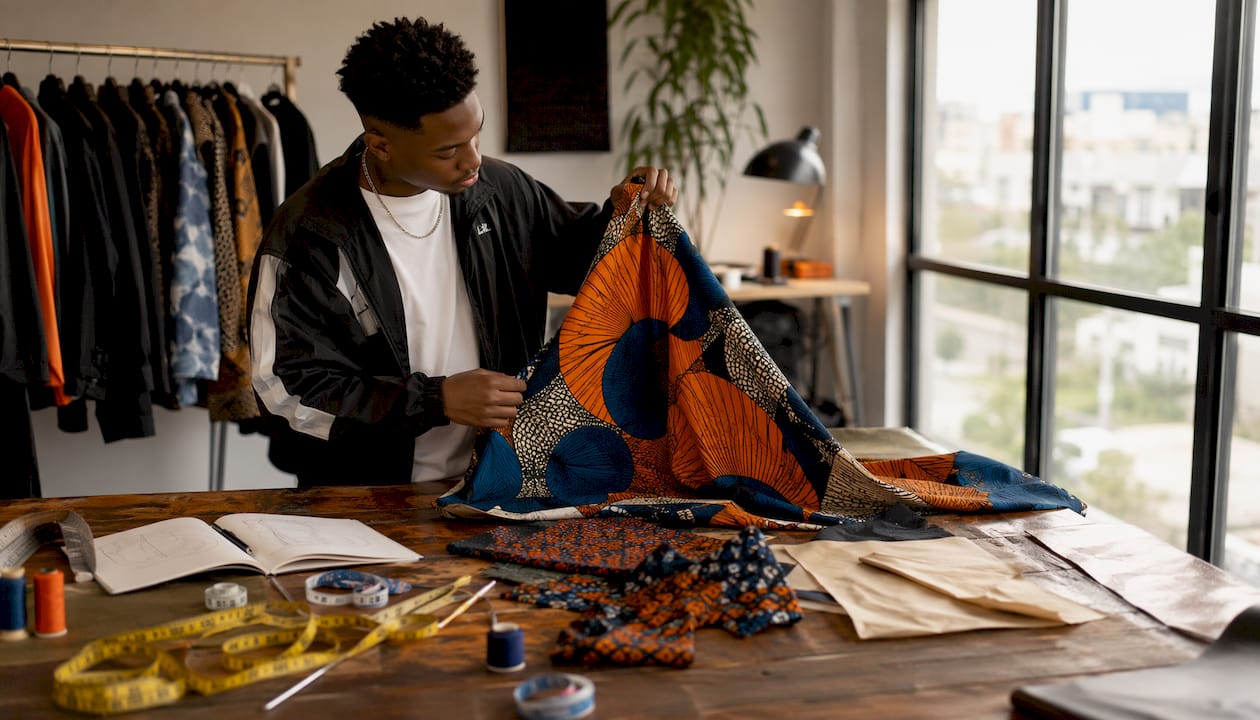
Mud cloth (Bogolan) from Mali is a hand-dyed cotton with a rough, earthy hand. It is medium-to-heavy and acts as a textural disruptor against smooth, minimalist foundations. A monochrome mud cloth tee under a denim jacket gives an outfit cultural grounding without excessive color contrast.
Aso-oke is a handwoven Yoruba cloth with a structured, almost architectural feel. Designers have reworked it into structured co-ords that transition ceremonial cloth into wearable silhouettes while keeping textile integrity intact.
Shweshwe is a South African indigo-dyed cotton with a crisp, papery hand. Lightweight and breathable, it layers beautifully as a base or light mid-layer in warm weather.
| Textile | Weight | Best layering role | Seasonal notes |
|---|---|---|---|
| Ankara/wax print | Medium | Mid or outer layer | Year-round; bomber weight works fall/winter |
| Kente | Heavy | Outer layer or accent | Fall/winter; scarves work spring |
| Mud cloth | Medium-heavy | Mid or outer layer | Fall/winter; monochrome reads well year-round |
| Aso-oke | Heavy | Structured outer layer | Fall/winter; co-ords work spring |
| Shweshwe | Light | Base or light mid-layer | Spring/summer; humid climates |
For hot, humid summers in cities like Miami or New Orleans, reach for Shweshwe or lightweight Ankara wraps. In cold, wet winters in Chicago or New York, removable layers that show print at cuffs, collars, and hemlines keep the textile visible without overheating you indoors.
How do you mix prints and silhouettes without losing the look?
The rules below are repeatable. Apply them in any dressing room and the look holds together.
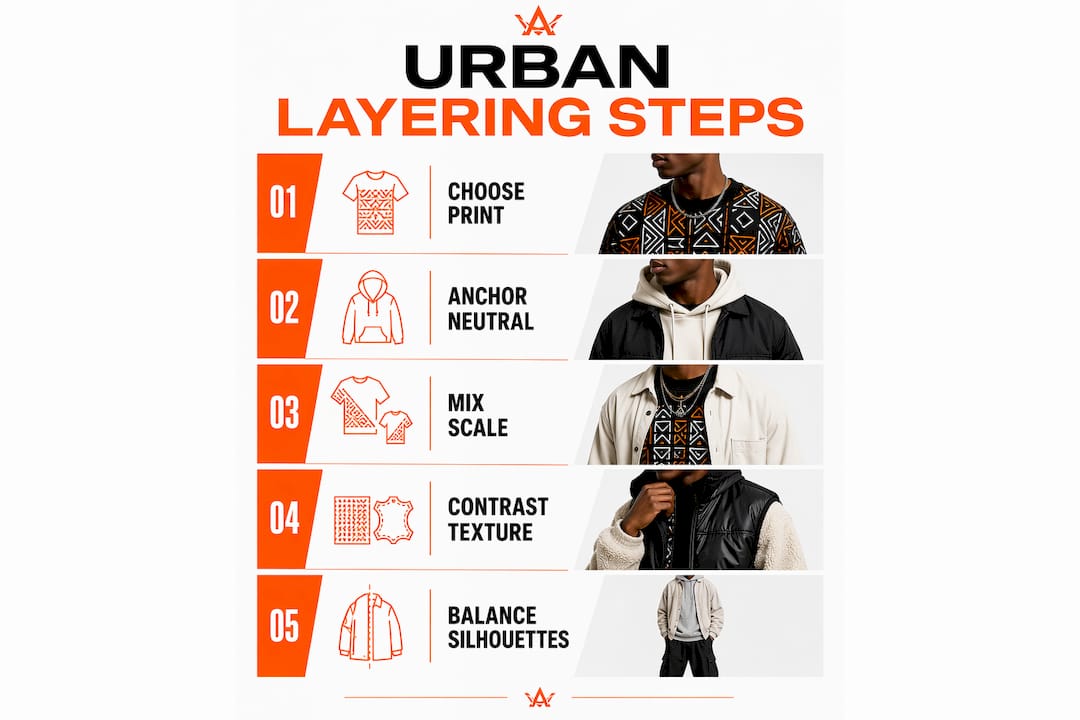
One print leads, everything else follows. Pick one African textile as the focal point and build around it with solids or very subtle textures. Two competing large-scale prints fight each other; one print with neutral support wins every time.
Manage scale deliberately. Pair a large-scale primary print with smaller-scale accents or solids; layer light fabrics closest to the body and heavier fabrics as outer layers. A bold Ankara bomber over a plain white tee works. That same bomber over a busy graphic tee does not.
Color anchoring: the 60-30-10 adaptation. Let neutrals (black, white, tan, grey) own 60% of the outfit’s visual space. The African textile takes 30%. A single accent color pulled from the print, used in a shoe or bag, handles the last 10%. This keeps the look urban rather than maximalist.
Texture contrast is your friend. Rough mud cloth against smooth denim, crisp Ankara against a soft cotton hoodie. The contrast creates visual interest without adding more color or pattern.
Silhouette balance: boxy outer, fitted inner. A structured or oversized outer layer reads cleaner when the pieces underneath are slim or fitted. Boxy on boxy creates bulk; boxy on fitted creates intention.
Pro Tip: Hold the outfit up to your phone camera in selfie mode before you leave the house. The small screen compresses scale the way a viewer’s eye does from a few feet away. If two prints compete at thumbnail size, they will compete in person.
Dos and don’ts for pattern mixing:
- Do: mix geometric prints with solid-color pieces; mix a large motif with a small one.
- Do: preserve woven border integrity on Kente and Aso-oke. Cutting across a border strip removes the textile’s intended visual logic.
- Don’t: layer two large-scale prints unless the colors are deliberately contrasted and you have tested the combination on-body.
- Don’t: treat border treatments as decorative trim to be hidden under a collar or belt. They carry cultural meaning and often the most visual interest.
Which garments make layering African textiles easiest?
Certain silhouettes do the heavy lifting. These are the pieces worth owning or repurposing.
Kimonos and short wraps in Ankara or Shweshwe are the most versatile entry point. Throw one over a plain white tee and jeans and the look is done. Spring and summer staples.
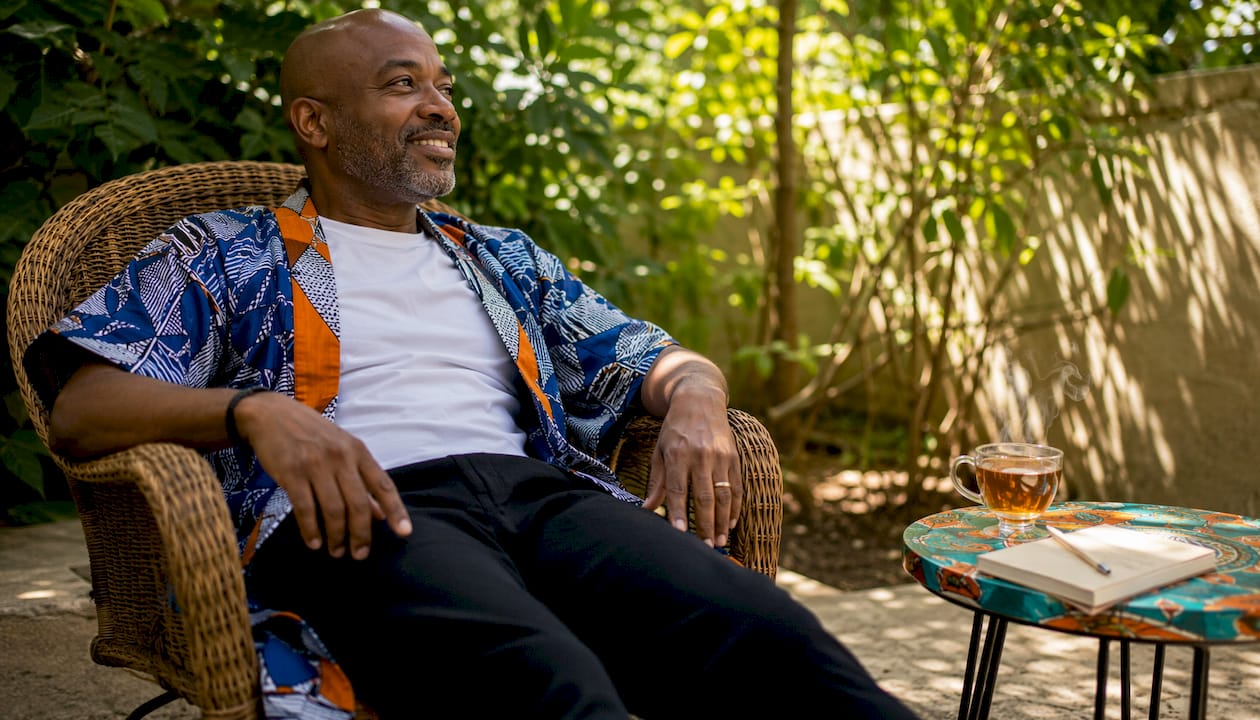
Oversized shirts in wax print work as both a top and an open layer. Worn open over a fitted black tee with slim trousers, they read smart-casual without effort.
Shackets (shirt-jackets) in mud cloth or Ankara are fall/winter workhorses. The utility silhouette grounds the print in a contemporary context. Building a streetwear wardrobe with African roots often starts here.
Bombers in Ankara or wax print are the most cited piece in urban African fashion. They pair with literally anything neutral underneath.
Unstructured blazers in Aso-oke or Kente-panel construction elevate a look to smart-casual or work-friendly territory without a tie or formal shirt.
Scarves and wide belts made from textile scraps are the lowest-cost, highest-impact accents. A scarf tied at the waist over a plain dress, or a wide belt cut from leftover Ankara, adds print without committing to a full garment.
Accessory accents from scraps: fabric patches on jacket elbows, a strip of Kente as a collar insert, a crossbody wrap made from a half-yard of Shweshwe. These small moves carry the textile’s story without overwhelming the silhouette.
Quick buying checklist for U.S. shoppers:
- Check for reinforced seams at stress points (armholes, side seams).
- Look for fiber content labels: 100% cotton wax print holds color better than blended substitutes.
- Prefer origin labeling that names the country or maker, not just “African print.”
- Ask whether the piece is fair-trade sourced or made by artisan cooperatives.
Six urban layering formulas you can copy today
These outfit recipes are built around the principle that one textile anchors the look while neutrals and structure provide balance.
-
Casual (spring/summer). Ankara kimono over a white fitted tee, light wash straight-leg jeans, white leather sneakers. Add a small crossbody in tan leather. Winter swap: replace the kimono with an Ankara oversized shirt worn open over a grey thermal.
-
Smart-casual (year-round). Aso-oke unstructured blazer over a plain black turtleneck, slim black trousers, white sneakers or loafers. One gold cuff bracelet. African-inspired workwear follows this exact formula. Winter swap: add a camel wool coat over the blazer.
-
Edgy street (fall/winter). Monochrome mud cloth tee under a black utility shacket, dark slim jeans, chunky black boots. Minimal jewelry; let the texture speak. Summer swap: drop the shacket, add an Ankara bucket hat.
-
Work-friendly (year-round). Kente-panel unstructured blazer over a white button-down, tailored charcoal trousers, clean white or black Oxford shoes. The panel blazer reads professional while the textile signals identity. Winter swap: layer a fitted black turtleneck under the button-down.
-
Festival/statement (spring/summer). Full Ankara co-ord (wide-leg trousers + matching oversized shirt), white tank underneath, flat sandals. Stack brass bangles. Winter swap: swap sandals for white chunky sneakers and add a neutral puffer vest.
-
Travel/transitional (all seasons). Shweshwe wrap skirt over black leggings, fitted white long-sleeve, neutral sneakers, Ankara scarf tied at the neck or wrist. Packs flat, transitions from airport to street. Winter swap: replace the wrap skirt with a Shweshwe midi skirt and add ankle boots.
Pro Tip: For DIY accents, a half-yard of leftover Ankara costs under $5 at most African fabric stores in U.S. cities. Cut it into a wide belt, a headband, or a pocket square. These small pieces let you test a textile before committing to a full garment.
How do you reference African textiles respectfully?
The Victoria & Albert Museum’s scholarship frames textile adoption as cultural evolution, not static tradition. That framing matters: it means wearing and styling African textiles is a legitimate act of cultural expression, provided you approach it with awareness rather than extraction.
Dos:
- Research the textile’s origin before you wear or rework it.
- Preserve border placement on Kente, Aso-oke, and Ethiopian shema. The tibeb border on Ethiopian shema, for example, signals ceremony, region, and social meaning. Hiding it under a collar or cutting across it removes that signal.
- Support makers: buy from brands with transparent sourcing, artisan cooperatives, or origin-labeled goods.
- Credit the tradition in captions when posting images. “Wearing Ankara wax print” is more respectful than “cool African print.”
Don’ts:
- Don’t slice ceremonial pieces in ways that remove their intended meaning. A sacred Kente cloth is not raw material for a patchwork jacket.
- Don’t present sacred designs as casual novelty or costume.
- Don’t buy from brands that use “African print” as a generic label with no origin information.
Quick respectful-reuse checklist:
- Source label present? (country, maker, or cooperative named)
- Intended use identified? (ceremonial vs. everyday)
- Border placement preserved where culturally meaningful?
- Maker or brand credited when sharing publicly?
Designers like Victor Alao demonstrate how keeping border integrity intact allows heritage cloth to enter contemporary fashion without losing its cultural weight. The same principle applies to personal styling. For deeper context on cultural identity in clothing, the diaspora experience adds another layer to how these textiles carry meaning.
What should U.S. shoppers know about care and buying?
Wax print cottons are the most forgiving. Cold machine wash, line dry, and a warm iron on the reverse side keeps colors sharp. Avoid the dryer; heat breaks down the wax coating that gives Ankara its characteristic sheen.
Mud cloth needs more care. Spot-clean where possible; hand-wash in cold water with a gentle detergent when a full wash is necessary. The hand-dyed surface can bleed on first wash, so wash separately.
Aso-oke and Kente are handwoven and often partially silk or rayon. Dry clean or hand-wash cold; never wring. Store folded, not hung. Hanging a heavy woven piece stretches the warp threads over time.
Seasonal capsule buying strategy: Start with three or four neutral base pieces (black tee, white tee, grey joggers, dark slim jeans). Add one heavy structured textile piece for fall/winter (an Aso-oke blazer or mud cloth shacket). Then add two lightweight printed accents for spring/summer (an Ankara kimono and a Shweshwe wrap). That capsule covers every formula in this article.
Accessory care: Brass jewelry tarnishes with moisture. Store it dry and wipe with a soft cloth after wearing. Beaded pieces should be stored flat to prevent strand stress. For woven bags or hats, stuff with tissue paper to hold shape and store away from direct sunlight.
Key Takeaways
Layering African textiles into urban streetwear works when one bold textile anchors the look, fabric weight progresses from light to heavy, and neutrals control the visual space around the print.
| Point | Details |
|---|---|
| One dominant print | Let one African textile lead; keep everything else neutral or subtly textured. |
| Weight progression | Wear lighter fabrics (Shweshwe, light Ankara) closest to the body; heavier pieces (Aso-oke, mud cloth) as outer layers. |
| Preserve cultural borders | Keep Kente, Aso-oke, and shema borders visible and uncut to maintain their cultural meaning. |
| Seasonal capsule | Build around neutral bases, one heavy structured textile for fall/winter, and two lightweight printed accents for spring/summer. |
| Start with Afrourbanapparel | Afrourbanapparel offers ready-made layered streetwear that fuses African textile heritage with durable, heavyweight urban construction. |
Why structured silhouettes and cultural integrity belong together
The conventional wisdom in African-inspired streetwear tends to split into two camps: maximalist print-on-print energy, or cautious “one accent piece” minimalism. Both miss the point. The most wearable and culturally grounded looks come from treating the textile as the architect of the outfit, not the decoration.
That is exactly the design logic behind Afrourbanapparel. The brand builds around heavyweight fabrics because durability is not a luxury feature; it is what allows cultural identity to show up in daily life rather than being saved for special occasions. A bomber that holds its structure after two years of wear carries more cultural weight than a flimsy print shirt that fades after three washes.
The cultural streetwear philosophy that underpins this brand also reflects what museum scholars describe: textiles shift meaning as they enter new wardrobes, and that shift is legitimate when it is done with intention and knowledge. Wearing an Ankara bomber is not appropriation. Wearing a sacred ceremonial cloth as a Halloween costume is. The difference is research, sourcing, and respect for what the textile was made to do.
Modern African streetwear is also moving toward reinforced seams, functional pockets, and unisex boxy silhouettes because urban life demands it. Afrourbanapparel’s construction reflects that shift. The pieces are built to layer, to last, and to mean something.
Afrourbanapparel: where to find ready-made layers that actually hold up
Most people who want to layer African textiles into urban looks hit the same wall: they find beautiful fabric but no garment construction that holds up to daily wear. Afrourbanapparel solves that directly.
The brand’s structured bombers, midweight shackets, and lightweight wraps are built for exactly the layering formulas in this article. Heavyweight fabric means the outer layers keep their shape; culturally inspired designs mean the textile does real work, not just decoration. Three pieces to start with: the structured Ankara bomber (pairs with any neutral base), the midweight mud cloth shacket (fall/winter anchor), and the lightweight wrap (spring/summer transition layer). Fit runs true to size, and the brand’s quality focus means fewer returns and longer wear.
Shop the full collection and build your first layered look from pieces that were designed with both the street and the culture in mind.
Useful sources and further reading
These resources back the cultural and technical claims throughout this article and are worth bookmarking for deeper context.
- Victoria & Albert Museum: Cloth of a Continent — The authoritative museum framing for African textiles as living cultural expression, not static tradition. Start here for historical context.
- Africa News Tracker: Styling African Prints with Western Streetwear — Practical outfit pairings and real-world examples of wax-print fusion with streetwear staples.
- KiKoi.it: African Print Layering Techniques — Detailed guidance on scale relationships and weight progression for layering prints.
- KiKoi.it: Seasonal Styling with African Fabrics — Tactical advice on showing prints at cuffs and hemlines in cold weather; useful for winter conversions.
- BellaNaija: Victor Alao’s ARIKÉ & OKIN Collections — Designer case study on transitioning Aso-oke into structured contemporary garments while preserving border integrity.
- OMIREN STYLES: Fikirte Addis and the Handwoven Cloth That Carries African Memory — Deep profile of Ethiopian shema and tibeb borders; essential reading before styling or reworking Ethiopian textiles.
- Afrourbanapparel: Build a Streetwear Wardrobe With African Roots — Practical wardrobe-building guide from the brand; pairs directly with the capsule strategy in this article.
- Afrourbanapparel: African Luxury Streetwear Explained — Brand context on the market and retail developments shaping African urban clothing collections.